December 2025
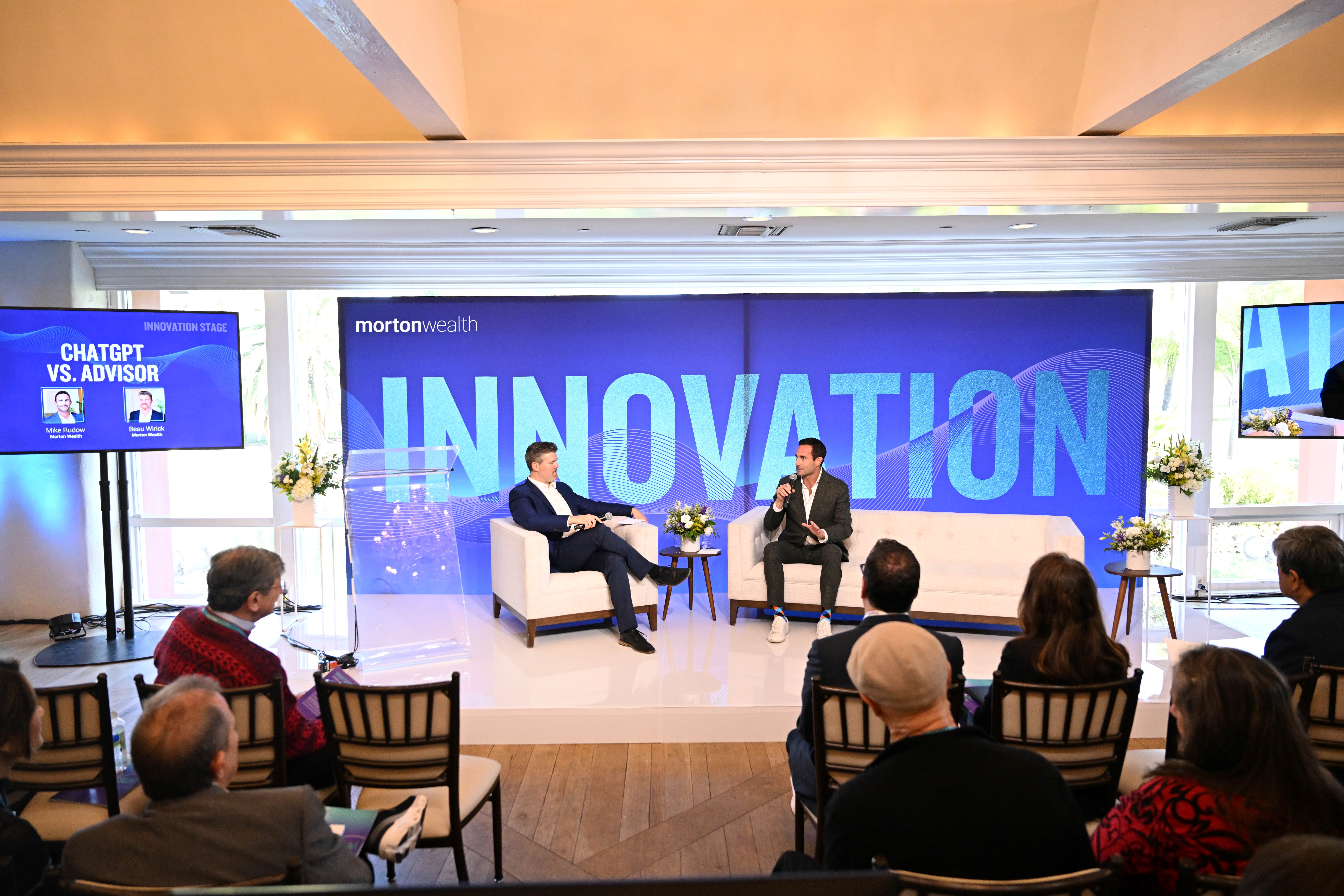
In this conversation from our 2025 Investor Symposium, Financial Advisors Beau Wirick and Mike Rudow break down how tools like ChatGPT can enhance efficiency in some ways while still falling short in areas that matter most: judgment, context, emotional intelligence, and true fiduciary care. Through live demonstrations and real client scenarios, they show how AI can excel at math and research while failing to understand the human stories that drive wise financial decisions.
Tune in if you're interested in…
* How AI chatbots can and cannot be used in financial planning
* Why 65% accuracy isn’t good enough when the stakes are your money
* The difference between data-driven answers and human-driven advice
* How Morton Wealth blends technology with deep personal relationships
Watch previous episodes here:
Maximizing Your Credit Card Points | Morton Wealth
Redefining Work/Life Balance Presence is Key | Morton Wealth
Welcome back to the innovation stage. We might even call it the cool stage.
I agree with that.
Mike Rudow is on the stage, so, by the transitive property, I don't know. Welcome to the innovation stage. Today we're talking about ChatGPT versus advisor. Has anybody heard of ChatGPT? It's a little thing happened three years ago in truly, artificial intelligence, as you all know, because you read the news, is changing the landscape of a lot of different industries.
And so one of the things that we wanted to dig in today is how is artificial intelligence affecting the industry of wealth advice? How does Morton Wealth use it? How does Morton Wealth not use it? And where we see it going in the future? So we're talking to artificial intelligence expert Mike Rudow about this, this conversation today.
So, you know, this should be a lot of fun. And it's kind of serendipitous because two years ago, I sat on this stage when AI was kind of a new topic, and I got to present on how businesses were incorporating AI into their business model. And it, you know, it was a new implementation. There wasn't a lot of businesses that had really started that process yet.
And then turn around two years later. Sit here today and it's a much different story. So I'm excited to talk about it.
It really is a different story. I, this is a joke. There's going to be a lot of jokes today. Okay. This is a joke, but I am now in a throuple with me, my wife, and ChatGPT.
I get home from work and she's like, oh, Beau, I was talking to chat GPT today and you will not believe what he said. I was like, and I was like, and he gets a little flirty with her. I got to be honest. I'm like, oh wow, that's such an insightful question you've thought really hard about. It's like, hey man, back up.
This is my this is my wife. Just give her the information that she needs. So ChatGPT is very integrated in my life for sure. And I think a lot of people use it, on a daily basis. And so that brings us to the question of how do you use it in financial advice. And so, Mike, I know that you've done a substantial amount of research on just the statistics around ChatGPT and AI in general. I'm wondering if you can share that with us.
No, I well, first, thank you for the clarity there. And it's interesting the throuple because now I understand why Daniela always calls me chat. Right. It's and I didn't think I was being flirty, I just was being polite. And don't worry, I'm happily married to Alexis. You're all good.
Now everything makes sense.
But no, I have done a lot of research on, you know, how AI has been implemented, and there's tons of facts out there. But what I wanted to do is kind of present the facts that really tell a story on how AI is, impacting the financial services industry. Right. And if you look at it, the financial services companies, about 85% of them have implemented some sort of AI strategy.
ChatGPT is calling us right now. Why aren’t I on that stage?
And that's a lot. That's a large adoption. But for the most part, they're using it to be more efficient, more resilient businesses, right. They're using it to automate tasks. They're using it for summarizing meetings. They're using it for some risk controls for fraud detection. The interesting part of that, though, is that most of these financial services companies are not using it for financial services, right?
They're not using it for complex investment planning. They're not using it for values-based planning or estate and legacy planning. Right. The numbers are less than 10% when you actually break that down and look at how they're using it. Right. And I feel like at Morton, we're very much in that boat, right? We're trying to create time for our employees to do the things that they love to do the things that are important, which is behavioral coaching, values based planning.
Right. Building real relationships. AI is great at the automation, right. And we use it for that. But I think we're doing a really good job of using it to free up our time so that we can do what's important.
Yeah. Just to give a few examples, if you've been in a zoom meeting with your advisor recently and your advisor has asked, hey, do you mind if I turn on our AI note taking?
That's a great example of where AI does really well, takes our attention away from taking notes. The SEC requires us to take notes in every meeting. So that's the perfect example. There's also software where if we're analyzing, say, a tax return, it can populate the data for us, for us to get to the analysis faster. And so these are ways that we get more efficient with AI.
But it's not necessarily replacing the, the, the actual, the actual work of financial advice. What is AI and what isn't AI? What AI is, it is a great research assistant. It is a wonderful Google search, and it is really good at doing black and white mathematical problem solving. Very, very good at that. What it's not it's not a replacement for critical thinking.
It's not a replacement for human intuition and relationships. And it's certainly not a financial advisor. So that I think, is the right way to think about AI in this current landscape of what it is and what it isn't. And so onto your next statistic about how accurate I can be.
And looking at that trend of adoption, right? When you look at this statistic, 50% of consumers in the US are using AI for some sort of financial advice. Wow. And if you look at the robo advisory AUM assets under management in 2022, that was about $2 trillion. The projections for 2027 going into it is going to be about $7 trillion. So huge growth there. And that could be a wonderful thing in the sense that it seems like it's democratizing financial advice, right, for people who maybe didn't have the assets under management to qualify for an advisor, are now able to get financial advice, but at the same time, that's really dangerous.
And if you think about fitness, for example, it used to be hard to become a member at a gym. Maybe it was expensive, but then these Globo gyms came up. You have 24 Hour Fitness, L.A fitness, and they've been able to democratize fitness so that anyone can afford a membership. Now, does that mean that anyone should walk into a gym and just start working out?
That's pretty dangerous, right? If you go in and you have no idea what you're doing, you're likely to get hurt or get someone else hurt, right? And there's a there's a routine to that. You should go in and you should get an orientation. You should learn the equipment, how it's properly used. And then you should probably get matched with a personal trainer, an expert, someone that's going to be able to teach you the fundamentals of how to squat, how to press.
And then once you've kind of gone through that, now it's goals. What am I trying to accomplish? Getting stronger, getting faster, getting thinner, whatever it is. You're going to customize a routine with that trainer to help you accomplish those goals. After a while. Yeah, maybe you could go to the gym and start working on your routine by yourself, but you're still relying on the experts until you've accumulated that knowledge.
ChatGPT and financial advice is the same thing. It can be really dangerous if you're just going into that asking questions without ChatGPT knowing the full backstory and you know the outputs only as good as the input.
That's such a good point. I think that's something that gets lost a lot. It's such a powerful tool. And, you know, it's a power tool.
I am not if you can't tell, I'm not really good at construction. Don't don't put a nail gun in my hands. I don't know how to use a hammer. I cannot use a nail gun. I will hurt you with a nail gun. And I think the same thing goes with ChatGPT. If you don't know how to use it and put the correct inputs into the prompt, then you're actually not going to get good results out of it.
It is a tool that basically garbage in, garbage out. Also, it's not always right. That's the other thing that I found with it. I've had it do mathematical problems that should be very easy for it and I have to correct it. Another example again, my wife talks to ChatGPT all day long and she we have a four month old baby.
And so she's always asking it about, you know, nursing and feeding schedules and sleeping. And the other day it concluded that she was a baby. The other problem with ChatGPT my wife is not a baby. ChatGPT does not know my wife.
I was confused by her question. So I apologize. Look, there is a fact. There is a statistic behind that.
And and that is that only 65% of the financial planning or investment answers that ChatGPT gives are actually accurate, right? That means 50% of the questions that you're getting answered are either misleading, incorrect, or missing information. Right?
I like how that math didn't add up.
Right. Yeah, there's math majors out there. So 35% of of the questions that you ask are getting answered incorrectly.
And you have no knowledge of which ones those are. If you don't have some sort of financial background, some sort of foundation built to understand what that question or that answer should look like on the other side of it,
Right. And there's and there's new evolutions of this. Right? ChatGPT is kind of a catch all large language model I server, but there's different apps that are getting created right now that are specifically this is artificial intelligence.
This is an AI advisor. And I just the most recent one that came out, I downloaded it, I put all of my information in and it's, it's pretty good at again, answering black and white things kind of like ChatGPT. But I, I found I was like, if I wasn't an expert in this field to ask the right questions, I can't get this thing to give me the right advice.
And so it's interesting when you when you know what you're talking about, you can know when the artificial intelligence is wrong. But if you don't know what you're what you're doing, you don't know when it's wrong and it's very confident and it'll tell you that you're a baby when you're actually a nursing mother.
Yeah. That's true. And and in life, there are so many few decisions that are actually black and white.
I mean, let's be real. When you're asking questions to ChatGPT, it's usually yes or no answers. ChatGPT doesn't know your life story. It doesn't know your dreams, your ambitions, your struggles. It doesn't know how to respond to the answers behind that, because it can only respond to that. You know, black and white, yes or no question.
So should we try it out?
I think we should. I think we should role play.
We're going to do what's called steal Manning. We're going to steal man ChatGPT and give it a question that it should be pretty good at. Right. It's it's a mathematical black and white question. Should I buy or should I rent a house. And we're going to keep the question vague because that's how the typical person will approach AI when they do use it as an advanced Google search.
Should I buy or rent a house? Okay, this is something that should be okay. Can we ask ChatGPT should I buy or rent a house?
Yeah, sure.
Okay, here we go.
It's thinking.
Okay, so when buying makes sense. Your plan is to stay in the house for 5 to 7 years. Your financial foundation is strong. You want to build equity and wealth when renting is a smarter move, you value flexibility. Your financial picture isn't fully solidified. The market conditions are unfavorable. These are really good considerations right? Like if you're looking at this, actually ChatGPT is doing a pretty good job of telling you the different factors that should go into your decision.
Right. And so, quick financial rules of thumb. You know, if you want to stay in there for seven plus years, you should buy if you're uncertain about the location you should rent, these are not wrong. Right. And then it even gets into the emotional and lifestyle check. And oftentimes you'll hear, oh, AI is not good at emotions.
It's actually going to ask you the question of like, well, what do you want. Right. And so if you like we can run the numbers rent versus buy and and do some calculators. Okay. I don't think that this is an awful response to that question. Right. Would you agree like it's it's not it's not awful. Mike, I want to ask you as a human financial advisor, the same question.
And I just want to show and we're not being like, again, we're steal Manning ChatGPT right now. I just want to show the difference in the quality of the conversation I might have with you versus what I might have a ChatGPT. So, Mike, you're my financial advisor.
Oh, what an honor.
And actually, yeah, that was pretty good.
So if anyone is hiring, I can do construction, fitness, right?
No, but should I buy or should I rent?
So let's role play. Like, let me be your first financial advisor as ChatGPT. Right. And we're going to walk through and we're going to figure out kind of the financial scenario. If you're even able to buy a house, what area you want to buy a house in, what the price per square foot is, if it's the right time to buy in that area because that's, you know, things that ChatGPT can be pretty good at.
So Beau, do you have a job?
For now
Do you have a stable income?
For now
Are you married?
Yeah. For now.
Do you have any children?
Yes.
Okay. Are your children in private school?
No, they are not.
Do you have any other dependents?
I have no other dependents.
Okay. Does your wife have a job?
Yes.
Is that a stable income?
No.
Okay. Do you have money for a down payment?
Yes.
How much money?
$200,000
So $200,000. Right. So from from the information that I just ask now, I can probably go as ChatGPT run some financial analysis, understand what you know, you putting 20% down on a $1 million house would cost based on interest rates today, right.
And call it a 30 year fixed loan. And then I could ask you the question, like, what's your gross income as a family? And I could take that and I can divide it by 12 and I could times it by 0.28, which will give me the ratio of whether you can really afford the mortgage on that house. And if that all comes back.
And now I say, hey, Beau, you can afford to buy a house, right? Now that you've gone through and done all of this, you're going to assume, I'm guessing, that that's the right decision for you. You're married, you've got a stable income. You're not planning on changing jobs or going anywhere, right? Your kids in school, all of these things would say, hey, we're going to be staying put, right?
So buying a house would be okay. Now let's switch to where I am your human financial advisor, Mike Rudow. And I've known you since your first episode of Doogie Howser. Right? We've worked together for a really long time now. Beau, I know you've been married for 12 years, and it's been kind of a volatile marriage. And none of this is real, by the way.
Yeah. So. And recently, you know, over the last six months, you've told me that you guys aren't even sleeping in the same room. Any time you guys try to communicate, it turns into an argument. You feel like you're more co-parents than you are. You know, a true couple, right? And then talking about your kid, he's amazing. He's having a lot of trouble in school.
He's been acting out, his grades are slipping. And it's not that he's not smart, is not that he's not loving or caring or respectful. It's just this is a big school that he's in, right? There's 40 kids per class, and you've told me that you think it might be right for him. And the best decision for your family to look at other opportunities, maybe private school.
And I know cash flow is tight, but you guys might be able to do that if you just tweak a few things. And then talking about Danielle. Her stable income, she hasn't been happy in her career in a very long time. And she's been thinking, you know, I don't feel fulfilled. When am I going to be able to get, you know, the opportunity to bite my teeth into something that actually makes me feel whole.
And on the other side of that, she's also kind of resentful to you because she's always wanted to have a yard where she can host. She's wanted to host kids birthday parties, she's wanted to have cocktail parties, and you just haven't been able to do that with the houses that you can afford to buy. And then there's your parents, right?
They're not dependent on you right now. But you've told me that your dad's starting to forget some things, and your mom forgets that your dad forgets things and they're on a very tight budget. And if anything happens to where they have a big hit to their pocket, you're the only person who could step in and kind of help them through those financial times.
Well, now when I look at what ChatGPT asks you all yes or no questions, figuring out, well, yeah, it's probably a good idea for you to buy a house because you're married, you've got a stable income, you don't have any dependents. Your kids not in private school. But then the reality of that is when you talk to someone who knows you, all of those things are variables that could cause you to say, hey, I'm going to step back.
Maybe I shouldn't be putting $200,000 locking that up into a long term mortgage. Maybe I need that money to help subsidize income, because Danielle is going to go get a new job and it might take a while. Maybe I need to help with private school. There's a lot of other things that need to be discussed that I don't think ChatGPT will be able to get to unless you have the wherewithal to tell ChatGPT all of these things.
And are you going to sit in front of a computer and say, well, I've got marital problems. My wife's telling me to sleep in another bedroom, right? So that's the reality of it. It's all about relationships. It's all about the relationships that we've built over time. It's all about me knowing your goals, your dreams, your ambitions. And I know that sounds cheesy, but that's the reality of it.
No, it's it does sound a it does sound a little bit cheesy, but honestly, when you were telling me my story which thank god that's not my situation, but I was I mean, that was a really emotionally moving story. And if you're sitting across from someone who you know and you're able to bring that type of heavy material up to help them make a huge financial decision, I think that is there's not a price that I would put on that, you know, to have basically a brother to walk through that those decisions with.
And I think that's a different relationship than, than what we have with, with ChatGPT.
And I think an important fact in that too, is at the end of the day, we're fiduciaries. We are here to help our clients make the best decision for them. And sometimes that's not the best financial decision. Sometimes it's the best life decision.
And it might cost them more, right? They might have to spend more. They might not be making as much money. But because we know them holistically, we know that that's going to be the right path forward. AI is not a fiduciary. You're putting in information. It's giving you facts that it thinks are facts. But you're it's not acting on your best behalf.
Yeah. And we don't know. We don't know when it's right. Because what 65% of the time. And that was, you know, a pretty simple a pretty simple question. If we had more time, we would go into more complex questions, like a one would be, should I quit my job and start a business right. If you were talking to Daniela in this hypothetical, I mean, that would be a much more in-depth Excruciating conversation that would take months and months and months.
Absolutely. Because someone that's never been a business owner. But I've heard from their friends, oh, yeah, I know this guy, and he just sold his business for 30 million, and now he's starting a new business. It's probably like they're thinking, why don't I, a business owner? Why don't I just quit my job and start a business?
And it's like, okay, there's a lot to talk about when you're when you're considering that route and it is important to have a team around you and people with experience who have worked with business owners, who have been with people who quit, you know, a guaranteed paycheck to go in and take a risk on, you know, starting something from scratch.
So I think it's wonderful. I really like how you eliminated that, Mike, truly. And and just to kind of bring it back to how Morton Wealth is treating this scenario, how we're using. I one thing that I want all of our clients to know is that we're not using AI and training ourselves how to know financials.
We're actually being very analog about, you have to know financial advice to become a financial advisor at Morton Wealth. We don't we don't rely on AI to to help answer your questions. And so I think is the number one thing that I want our clients to walk away from today is that we value the human expertise so that we can use the tool well, and then that the emotional expertise is just something that we put such a heavy premium on.
You know, like we the people who we tend to attract at Morton Wealth tend to be people who can have those very honest, emotionally heightened conversations with their clients and are really helpful way.
Yeah, no, I agree, I we've done a good job of embracing AI. And I would be lying if I said it hasn't made us a better organization.
It really has. But it hasn't replaced human behavior and human judgment, and I don't think it ever.
Well, we called the cyborg advisor. Now, you know, you want to be like half machine, half human. That's like the perfect sweet spot where you know how to use the tool. Really well. But you're not a robot. So that's what we had to say about AI today.
I hope you enjoyed it. If you have any questions, come up and ask Mike anything you want. He is an expert in many, many fields, so thanks for joining us.
Thank you guys.
Wow.
Disclosure: The information presented herein is for educational purposes only and is not intended to constitute a recommendation or endorsement of any specific credit card. The views and opinions expressed are those of the interviewees and may not necessarily reflect the views of Morton Wealth. The above information may not be representative of the experiences of other clients and does not provide a guarantee of future success or similar services. These views are not intended as a recommendation and should not be relied on as financial, tax or legal advice. It should not be assumed that Morton will make recommendations in the future that are consistent with the views expressed herein. Credit cards discussed herein are based on general features and may not suit every individual. Benefits and rewards mentioned are subject to change by the issuer. Please verify current terms before applying. No compensation was received from any credit card issuer mentioned herein. Past performance is no guarantee of future results. You should consult with your finance professional before determining which credit card best suit your situation and before implementing any transactions and/or strategies concerning your finances.