December 2025
In this candid conversation, Clay and Megan unpack how rising interest rates, soaring construction costs, and frozen capital markets have reshaped real estate investing even as housing demand continues to grow. Clay explains why Grubb Properties’ long-term focus on essential housing and young professionals helped them weather the storm, why transparency during downturns matters, and why demographic trends still point to a powerful long-term opportunity.
Tune in if you're interested in…
Watch previous episodes here:
Ep. 166 Transferring Wealth Wisely
Ep. 165 Finding Purpose in Your Golden Years
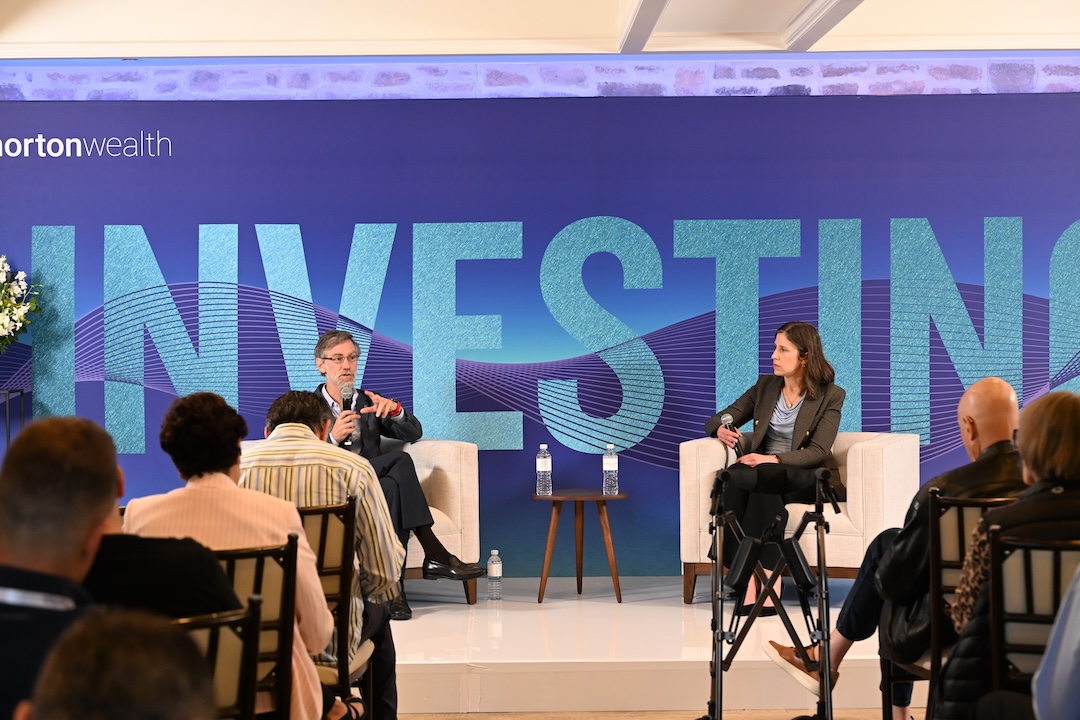
Well, welcome everyone to the investment stage. The best stage. I don't know if we're having a technical competition or not, but I'm Meghan Pinchuk. I'm the Chief Investment Officer at Morton Wealth, so it makes sense. I'm slightly biased for this stage. Though, ironically, this is actually my only session today.
But we have an awesome lineup of managers down here. A lot of people that many clients will be invested with will recognize from their statements. And as Beau alluded to, it's neat to be able to hear... I talk to these guys all the time, and it's nice for you guys to be able to hear directly from them and hear about their views and what they see about what's been happening, their comments on the current landscape, and then where they see things going forward.
Because it's we live in an interesting time. So so we're kicking it off today with Clay Grubb. He is the CEO of Grubb Properties and they do real estate equity investments. I was going to say you guys are one of our oldest managers in terms of when you started, but that doesn't sorry, I don't call you old though.
Based on what I look like.
No it's not. But your picture like like yeah, it's, you know, thought that was to be one of those like update your driver's license at some point. But but Grubb Properties was founded in 1963, so we've been around for a minute or two. And what their main focus is on is their real estate equity investors.
And their primary focus is essential housing. And so what is that? That's basically homes, apartments across the country. And they're looking to be in urban areas, where there are employment opportunities and public transportation. And they're trying to make things more. It's not affordable housing like the technical government term, but more affordable, especially for young professionals. And to a large degree, that's a demographic that's really overlooked.
You get people who want to live in these big cities and they can't afford housing. And so it's trying to find or create housing in those cities that will be more accessible to that specific demographic, which is a growing demographic. So Grubb has over 250 team members there that close over 250. It's a range. So over 250 team members, and they're what you call a vertically integrated firm.
So they kind of do a little bit of everything. They'll do the construction management, they'll do property management, the lease up, they'll get the financing. So they sort of do everything. And that's why they have such a large team to handle that. So I want to get into that today a little bit about the current environment that we're in.
And then just to recap what's been happening. A lot of people in the room actually might not know this, but real estate has been having a really tough time the last few years since interest rates started going up in 2022. It's been a really big challenge for real estate. If all of you own your homes in the room, probably doesn't feel that way because actually home prices, especially in Southern California, have continued to go up kind of to a crazy level in some neighborhoods.
But other commercial types of real estate, including apartments or call it down 20 to 30%, you know, across the board. And that's just the gross price, the price, if you have leverage on it, sometimes your investment has suffered even further. So you guys play like when when we first met you, we first invested in 2019. You were worried about interest rates rising.
Thinking about that a lot. And I think as a result of that, you guys were positioned more conservative than most. But even with that conservative positioning, you guys haven't had an easy time of this current decline.
We've definitely not had an easy time. And, you know, it's interesting. You you never know what's going to happen with interest rates. One thing that I've learned over the many decades doing this business, that whatever I tell you, interest rates are going to do, it's going to be the opposite. And so we've got to be prepared for that.
And I think that's one of the things that we really focused on. Once Covid hit, we saw interest rates plummet and we had the choices of either selling or locking financing long term. And and we did a lot of both. And so today we've actually got a couple loans that are locked at one at 2.39% for 35 years, one at 2.44 for 35 years.
And those are going to pay great dividends over the long term.
I think, though, you guys had some statistics, too, about how quickly some of the rates went up and then also how much some of the costs went up to the building, because the projects, to your point, the ones where you had interest rates locked in and they were finished, I think those are amazing. Those are going to be incredible trades.
It's more the midstream projects, right? Stuff that was in the middle of construction that I think has been really challenging.
Yeah. So, so I'd like to go back a little bit just because for most of you folks are, you know, when you're investing, you think long term speculating. You're, you're, you're betting on what's going to happen the next 24 months. Real estate investing is a long term strategy. It's expensive. Transactions are expensive. Getting in and out of real estate is expensive.
And so one of the things that we focused on was trying to figure out what's the most resilient part of the market. And, and we were very fortunate, you know, before 2008, we went from 38 properties down to just five by January 108 and had not invested for three and a half years. And we started investing again in December of oh eight.
And so, a really great run. But the biggest thing we were focused on is we realized that, you know, housing was going to be something that was critical. People have to live somewhere. But, you know, most developers are focused on where they can get the highest return because they're trying to get in and out. And so most development goes to the very high end of the market, trying to cater to where the wealth is.
And then there's a subsection that caters to the affordable component of the market, but there's nobody that's catering to all these young professionals. And the reality is, is that's the largest demographic to ever come through the United States. And so if you've got the largest demographic and them having very few options to live in, we felt like, okay, that's going to be a really great place to play.
And that's where we focused and we've been real conservative, Covid hit. We were very fortunate because the headline was one third of America Doesn't Pay Rent on April 9th. CNN's headline, second paragraph was Grub Properties. I collected 94% of their rent, and we collect over 98%. Our rents every month of 2020 and end of the year with the highest occupancy, the highest rent in history of the company.
We realized we're catering to all these central employees, America. These are the ones that had to keep the hospitals going, you know? And then we saw interest rates plummet. A flood of capital came into the southeast. We got very nervous. We haven't made a new investment in the southeast. All that capital came out of California and New York.
We felt like, hey, it's a great time to go into California. New York. People are going to still want to live in these markets. And so that's what we shifted to. But between 20 and 23 development across cost across the nation went up 50%. So if we could build in Southern California for 500,000 unit, now it's 750,000 a unit.
And our markets in like North Carolina, we could build for under 250,000 unit. It was, I said, more than 350,000 unit. But then the fed responded by raising interest rates. The fed funds rate 2,000%. Well, values came down 34% after that in a very rapid time. So in North Carolina, we used to build for less than 250,000. We could sell it if we wanted to sell it for over 300,000.
Today, it cost us over 350,000 to build. But when it's done, it's worth less than 250,000. So it's actually at worst it's.
Not good math.
That is not good, man. That's why we hadn't made a new investment in the Sunbelt since 2019. Because that math is very, very challenging and has been very tough. And so as a result, we're stopping building all housing across the United States at a time when the largest demographic in the history of America desperately needs housing.
You made a comment when we were talking about this session about how it felt more lonely this time, because this was this real estate like, to give everyone context, this real estate decline is on par with like 2008, in terms of how devastating it's been for real estate is a sector, but everything else is doing great.
Yes, well, it has felt lonely and we have talked about that a lot.
Well, I mean, at least you have the stock market crash that would make you feel a little better. Is that what you're running for?
This is painful. 2008 was you know, we had been preparing and preparing and then it happened. And then it was still way worse than you could ever imagine. And, and I remember that Monday in September of ‘08 being the worst day of my life, we had our biggest investor was a huge hospital system. They had canceled every investment across the system because their bonds had been downgraded.
And we were like thinking, well, we got a countercyclical partner. This will be great. This is our only project. We're trying to do that one, had to stop. And so we had to really cut a bunch over here. And I came home and turned the TV on. And Lehman went down that afternoon, and it didn't feel very lonely.
This time. Yeah. It's been like, you know, I met an investor the other day, and he's like, well, you know that half a million I messed with. Yeah, I could have put an Nvidia like. Well, yeah, you could, I hope you put some in Nvidia. But that's why you're diversified.
I think to one thing, you guys have been more proactive in terms of actually making adjustments to prices. We've seen a lot of other, especially some of the big real estate groups kind of try to hide some of the pricing moves that have happened or just say, well, they don't need to report on it that way. And so as a result, it's also lonely, even within real estate, when you're transparent as to, hey, if you're selling something today, the price is down.
And that can be, I think, a little tricky as well for investors to digest.
There's no question nobody, nobody likes to hear their values went down. And, but a good friend of mine always says you want to be the first to deliver the bad news and not the last. And, of one of my board members for ten years, had been the CFO of First Union, became Wachovia, and Wells Fargo eventually, merged into it.
But he was long gone before all that. And, and he's always, like, looking. You want to get the bad news out as fast as you can, if you've got to take write downs, if they're coming, get them out the door. And that way you can start growing again. And it's been really painful. You know, we've taken about $400 million worth of write-downs during this period.
But I am happy to say that since beginning this year, we've been taking significantly more write ups than we have write downs. And, and our news project is, is going to be a pretty significant write up. But you're excited about.
I think you were also one of the first to get the bad news, and also probably one of the first to not quite call the bottom, but to say, hey, it looks like things are really turning materially. So I guess on the on the good news now, things do seem to have improved debt markets in particular.
That was a tough one. I know for anything. Again, that was financing midstream projects. There was just no debt. And now all of a sudden you're getting very cheap debt again.
I wouldn't call it very cheap.
Yeah. Very relative to where it was.
Yeah. I mean, it was two years ago. It was really scary when the fed shut the interest rates way up. Not only did you know, you think the cost of borrowing goes up, but the reality is, is every lender panicked and they stopped borrowing at all. They stopped lending at all. And so I said, and you know, you're trying to run a business in a market where there is no capital.
Nobody wants to invest. You certainly can't look at an investor and say with the straight face that, hey, this is going to be a good time to invest. You know, don't worry that values are going to plummet. So we stopped raising capital. We closed our fund early, despite we had not hit our targets because we were worried and, and it was it was really, really scary two years ago.
And then, Labor Day two years ago, I seen this thing called private capital, started kicking in private credit and there started being some money in the system as expensive. Now, for good bars and good product. You know, our, our last, we recently bought a deal here in Los Angeles and probably a year and a half, two years got probably couldn't have gotten a loan a year and a half ago.
I could have probably gotten a 55% loan and would have had a half a dozen bidders. And this summer we probably had 50 bidders and significantly lower borrowing cost.
So the demographics you mentioned, right, that that young professional who's serving, I guess, can you share a little I think that's something you guys are get really passionate excited about because you're saying, look, now, if you can hold on, if you can finish the projects and move forward, the long term positive momentum for this strategy is pretty significant.
Oh, I don't think there's any question. So, demographic wise, I believe it's there's probably more I think it's 33 year olds have never, ever been in the history of America. And so that is kind of the heart of the millennial. But the reality is peak births in the history of America was 2007. So there are more 18 year olds born in America than any other year in the history of the United States, both before then and since then.
And so the real demographic bulge is that 18 to to really 35 year old. And it was interesting when we started focusing in I had three young single females that really pushed the brand of what we do and really that they're the demographic we should focus on. So our design filter is the 35 and under single female. We decided to really focus in on her for a few reasons.
One, she now makes a 50% premium in college graduations to her male counterpart. At the time, she was still suffering about a 12.5 gender pay gap. Now I'm hearing Scott Galloway and some folks now say she's actually getting a gender pay premium in a lot of these urban markets. And the reality was we didn't have to get into this amenity race war, so we didn't have to have a Sunday football game room because she really didn't care about that.
We didn't have to have the golf simulator that breaks down every quarter. And costs a lot of money. And so we could really tailor in to, what we're focused on. And one of my jokes is that our studio 400 square foot studio, she calls it a studio and puts mattress in the, you know, it's the living room bedroom.
And, and he tries to stuff a mattress in the closet and call it a one bedroom. And, because we even have a walk in closet in that one, because we know that's important to her, and we know a large vanity in the bathroom is important to her, and security is important to her. And so really focusing in on that allowed us to get significantly more efficient.
And we feel like that demographic is is here to stay.
And when the interesting stat is, 6 or 7 years ago, the median age of our renter was probably 26 to 27. Today, the median age of our renter is 31 to 33 people.
People are renting much longer than they used to. It can't afford the all the single family homes that have continued going up.
So I'd love to. I do have I have more questions. I can keep talking, but, does anybody else in the audience would like to ask a question? Oh go ahead. So from.
A residential standpoint, there's a lot of sellers that have fixed their interest rates right? Everybody's had a had the chance to refi, which is keeping homes from going on the market, which is likely keeping prices more stable. Any thought on what that trend is going to look like going forward?
Well, I mean, I think that trend is going to stay the same. I mean, if you've got a two and a half to 3% interest rate, you're not motivated to sell. And now if you've got Airbnb as an option or even long term renters, there's plenty of renters in in the pool. And so really America is had a really tough time.
But it's interesting. It's almost every urban market in the world is struggling with how do they provide housing that people can live in and afford. And, and I've got a lot of opinions on what we need to do to help address that. And I've spent a lot of time writing about this and working on it. I do think it's critical that economic mobility become an important, important part of every everybody's life and help them promote economic mobility, because, you know, when the tide rises, it all boats are lifted.
And so that's part of the American dream is having economic mobility. We put a lot of energy and mobility in general, just in the way we think. We talk about our residents related to economic mobility, social mobility and physical mobility. And one of the things that but is, I think is the biggest challenge is, is the car.
You know, Meghan was laughing about, you know, I came up from Venice Beach this morning. She's like, I hope Clay remembers about the LA traffic.
And, otherwise, I was just going to share my thoughts on real estate for 20 years.
The average American spends $12,000 a year on a car. Well, you know, our median renter in the Sunbelt makes $52,000 a year. If they don't have to spend $12,000 a year on a car, changes their economic mobility. I actually live in one of the largest apartments in our portfolio, and my average gas power, water sewer is less than $50 a month.
You know, those types of things really help with the economic mobility. It gives them a reason to stay with us longer. And, and obviously social mobility, we don't we don't need to go there. But that's a big part of this generation. I think.
Okay, you guys can fight it out. I actually have two unrelated questions.
But the first question is, why is the city on land one Porterville, one third to central California, just south of, Fresno. And both projects are. So with, one property can build over 100 units. The other 150 units with your company. How does your company view the Central California area as a market today, and is there an opportunity there, or should I sell it for another 40 years?
Yeah. Well, see, the one of the things that we talked about is development cost. And the construction cost is too high to make the numbers work pretty much anywhere in the United States outside New York. We're delivering two. We just delivered one project in New York, and it's crazy. It, it's we are 84% leased. We open April, and the average rent, our average unit size is 580ft².
And our average rent is north of $5,000 a month. It is crazy what's happened in New York. So that's the one anomaly in the United States. Actually, from a personal standpoint, I'm most bullish on San Francisco is the one where you can buy the best opportunities now, because I was really driving that. And then LA with the Olympics come in and World Cup and and unfortunately all the product, they got lost in Pacific Palisades, which was really heartbreaking.
But there's got to be a lot of labor that's going to come in. So I'm very bullish on those three markets as being the ones that will lead. But we're a long way for me. Me to make numbers work. We can build something new in these markets.
Kaizer’s going to actually come in. He's much larger than me, so he's going to drag us off the stage shortly. I think we have to wrap up, but I see a lot of questions. Clay will hang out.