December 2025
This chapter of freedom we work so hard for is called the “golden years” for a reason, and while the end of a career may feel like the finale, it’s actually the doorway to a plethora of new opportunities, relationships, and experiences.
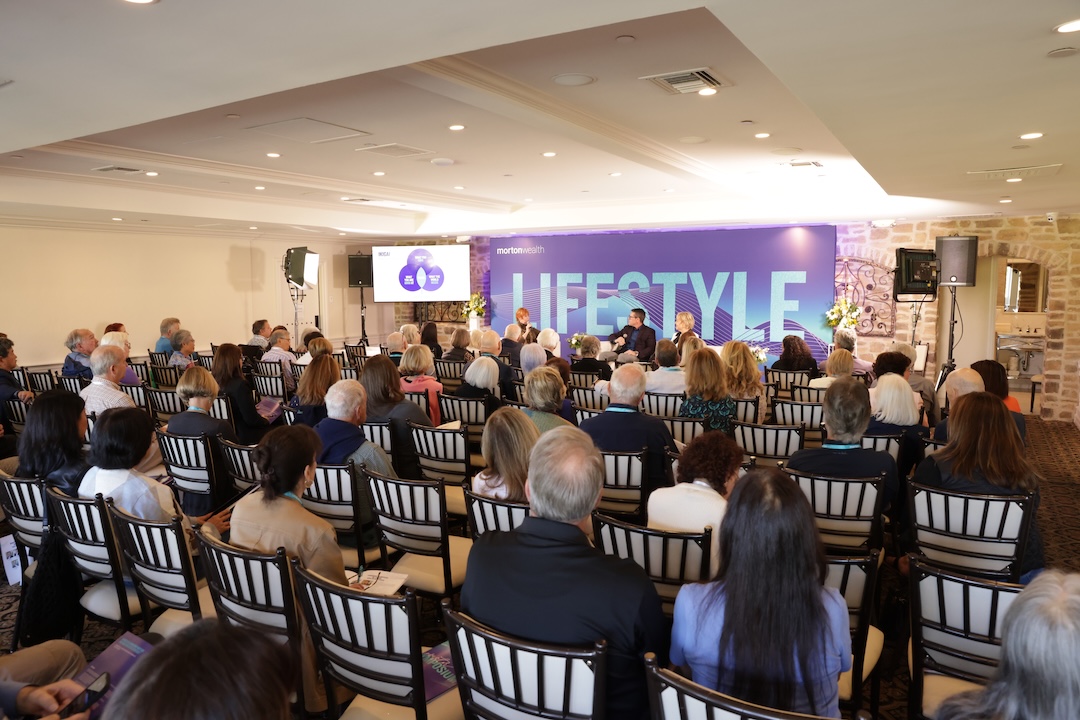
Join Wealth Advisors Priscilla Brehm and Joe Seetoo, along with Liz Dietz, founder of Love of Aging, as they explore practical ways to create purpose, wellness, community, and joy in retirement. Fulfillment doesn’t end when work does, and it can even evolve into something greater than before.
Tune in if you're interested in…
Watch previous episodes here:
Ep. 164 Investing in Whiskey, Marinas & More with Cordillera
Ep. 163 The Realities of Selling Real Estate
Good morning everyone, and welcome. The name of this session is Finding Purpose in Your Golden Years. My name is Priscilla Brehm and I am a founding partner and, currently a wealth advisor at Morton Wealth. Next to me is Joe Seetoo who is a partner and wealth advisor at Morton. And Liz Dietz who is a very dear friend, longtime Morton client, and she has joined us today from San Miguel de Allende in Mexico.
When you think about the golden years, you think, floating in a pool, having mai tais, having time to do whatever it is that you want to do, but sadly, so many retired adults suffer from depression. Just in a time when they're supposed to be enjoying life the most, depression hits. And part of the reason for that is they struggle to make that transition from working in as, you know, as a paid person to enjoying life as an unpaid person.
And we have chosen the Japanese concept of ikigai as the framework for our conversation.
Well, what is ikigai? It's basically your reason to get up in the morning.
And if you visualize four intersecting circles, in the first circle is what you are good at. In the second circle? What do you love? What really gives you joy. In the third circle? What does the world need? And in traditional Japanese ikigai, there's a fourth circle which says, what can you get paid for? You're in your golden years.
We're going to completely ignore that circle. So right here where all of these circles intersect, that's ikigai. And that's the focus of our conversation this morning. So, Liz, my question for you. My first question is, during your career, you built and sold successful software companies and, the last one that you participated in building, you finally said, okay, this is it, I'm going to retire.
And now you're what I would regard as being one of the most successful retirees I've ever met. What would you say is the key to your success in retirement?
Thank you. Well, you know, I did. I loved working; I was in the software business, with publicly traded companies. And I loved it, loved it, loved it. I love the people. I loved the money. I loved the customers. I loved the travel. But, you know, my husband, the long-suffering spouse at home, and he... I mean, he loved it, I loved it, but at some point, he's like, come on, you know, how long are you going to keep working?
And I'm like, well, okay, I'm going to start preparing. So at 65, I started thinking, okay, I'll get ready to retire, and I'll retire at 68. I thought, well, I'm going to work until I get the last penny out of my Medicare and my Social Security. I didn't need to do that, but it was just a thing.
So at 68, I finally retired, and he got to fulfill his dream because we've had homes in San Miguel which is like a giant retirement community in and of itself, all the expats... and they do so much. So we finally, he got to build the home. He wanted to build Spanish colonial architecture and all that.
And it's a beautiful, beautiful home. And, I lost my point, but I was not working, so I had to get busy. I really, I really had to get busy, you know, and start to do things. And I would say before I get into what I did later is that attitude is everything. I think Priscilla mentioned that you've got to have a healthy attitude.
You need to keep busy. You know, it's a transition and, don't buy into that over the hill nonsense. You see those greeting cards? Don't look at that. It is the best time of your life. You know, it's the time when you can actually enjoy things. And I highly recommend. I brought a visual aid by a local psychologist, doctor, Alan Castell at UCLA, and he's very famous in gerontology and aging.
You start to forget a few things, but your brain is actually improving in wisdom in other ways. So we sort of moved more from what we needed our brain to do, remember every single thing, and work, into being more of an advisor and being wise.
So, you've got to stay busy. Number one, you have to find a purpose. You need something to do. Whether it's joining the Rotary Club or, volunteering like I do at an organization called Feed the Hungry, where we feed 6000 school meals a week to children in the poverty level. And so I joined the board, and I do, as you might guess, fundraising and outreach and things like that.
I have no problem asking people for money. Go figure. And so but I love it, I love it, and it gives me a purpose. So you've got to find that, you know, joy in your life. There's so many different things you could do, but sitting at home isn't really always the answer.
So, Liz, I love what you said about the volunteering. And, Joe, you do a lot of volunteering. You and your wife were recently recognized by the Boys and Girls Club for some of your volunteer work. What is it about volunteering that you think is important in your golden years?
So, the thing that I believe and it goes to your point, and I think this slide is perfect for it. I think we as humans have a fundamental need with our fellow man to provide value in our relationships. And I think volunteering allows one to do that to serve others, and that you really find purpose through that volunteer work.
What I love, and I see with some of the board members that I work with, is they've had successful careers as an attorney, as a CPA, maybe as an executive, or in marketing. They can take that skill set and transfer it now to an organization that now serves others beyond just for the paycheck. It allows those who are, you know, that have the skill sets to interact, maybe with those in different generations, different life experiences.
So it keeps them sharp. It's a perfect way to combine what you love, what the world needs, and what you're good at. I'll share a quick story. I was at the National Boys and Girls event for the five years of the year, from around the United States. I happened to be at a table with a couple who's in their golden years, and they have a standing scholarship fund for these five kids who are now going to college.
Her only two requirements were one, that they write her a letter every month that they're in college. So it gives them a way to build a relationship. She sees what's going on in their lives and that the money is actually used for like pizza. Going to movie clothes. It's not actually for for school itself. It's for more life experiences.
Many of these kids came up to her, gave her a hug. You could see they really viewed each other as an extension of their families. And it filled up her bucket. You could just see what she's getting out of this in terms of purpose and fulfillment in her golden years.
So in a sense, if you think about, what does the world need? Sometimes the world could just be your family. It might be your community. It might be your religious faith group. Maybe it's planet Earth. But, when we think about what does the world need it, we look outside of ourselves. Liz, for women in their golden years, it can be quite different than it is for men.
What would you say is important specifically for women in their golden years?
Well, for women, and I can talk about men, but for women, you know, it's different for everyone. But statistics show that women live longer than men. We just do for could be a whole variety of reasons. But typically the men go first. And research also show they do. And you know, in my case same thing. We'll talk about that.
But research shows that social connections and the network of friends is what really carries you through. I can't stress that enough. And women are typically better at creating and maintaining relationships. Men. Do you think that's probably true? I mean, we're the ones to go out to dinner parties. We planned the vacations, we make friends with the neighbors, and we do all those things.
So we're much better at just reaching out, asking for what we need, and making relationships. But for men, you know, you you can go out, go have lunch with your friends. It doesn't take anything fancy or special to create relationships and maintain them. I, we're also better at sharing internally. Like, you know how they say men, men are from, Mars, women are from Venus, and we don't mind getting together and talking about, oh, I'm really how are you doing?
Well and blah, blah, blah, and asking for support from friends and all that. So we're better at that. Men are a little bit more stoic. And, you know, I'd watch my husband with his friends smoking cigars and drinking some tequila, but they didn't really get into their feelings. Believe me, they were talking about sports or politics or those kinds of things.
You know, we talk about different things. But just get out there and find something to do. Just be busy. Lunch, what have you. It's really important.
So, Joe, why don't you address that question from the gentleman's point?
So I'm Gen x. I was actually on a recent retreat with a couple of my guy friends. I think it is changing a little bit with some of the younger generations. But the three of us, we're talking about our fathers and sort of lamenting about the fact that they were successful in their careers, but now largely in their 70s and 80s, they're stay at home.
They don't really have a lot of hobbies. They don't really, you know, do much. And it was almost like the three exact same stories. And maybe I'm over generalizing when we're working and, you know, job promotion, financial security, climbing the corporate ladder, I believe it's a little bit of a modern form of hunting and gathering for men.
It fills a little bit of a primitive need. It's easy to focus on that in terms of your identity because it's rewarded, and because there's the reality of taking care of those that are, you know, under your, your care, your kids, your spouse, things of that nature. But the problem is, when you get to a level of financial security and ready to retire, that the hobby, the hobbies have gone by the wayside.
You haven't kept up with friends. And when you're now ready to make a pivot, and I actually have to to do these things, it's hard. And I agree, men are generally not as good at asking asking for help, coupled with the fact right that so that loss of structure easily leads to isolation. You talked about depression a little bit early on, and now we live in a society where we have distraction all the time, YouTube, our phones, we can order food in and literally just sort of isolate, and it's, I think, obviously a real problem.
I was actually talking to our CEO, Jeff Sarti, a couple of weeks ago, and he was sharing with me a study around the idea that you have to have probably four hobbies or passions as you enter retirement to have an engaged and fulfilling, you know, time at that point. So I'm a real big fan of having a what I call a moving towards mindset, really.
So much so that whatever you're leaving behind, whether it's your career or what you were doing in the past, and you're transitioning to this time of your life that you're so excited about what you're going to gain that you don't have regret. And remorse and what you're leaving behind. So I do I do think fundamentally is there are a few things that can address this issue.
I love that. Thank you. When we think about golden years, we also think, maybe my purpose is to just to stay healthy. And, Liz, you have this amazing attitude towards health and plan that has a lot of components. Can you talk about that?
Yeah. Well, don't be put off by my plan. This is just mine. But, you know, when I was younger, in, you know, high school, college, etc., I was a competitive swimmer. And, you know, we'd run ten K's every weekend and do all that. But then when I started working, I'm very binary, you know, I'm either working or I'm not working.
And if I'm not working, I'm doing all those things. But when you're working, I was all about work. It took a lot to, you know, be in the software business and do some of the things that I did. But then when I retired, I thought, okay, you know, I want I don't want to be infirm. I want to be healthy.
And so I took on this charge of really getting back in shape. And so I hired a personal trainer, someone that people I knew had used. And they called her a well, I could say, I guess I could say the word hardass, but she's very good. And, so three days a week I work out with her. I go at 830 in the morning, six days a week, three days a week.
I do strength training, and it is especially for women. But men to strength training is everything. I mean, it's good for your brain. There's so much research you can't even turn on a TV channel or open a magazine without reading about it. But strength training is king. And then the other three days a week I do a, a group class which features which focuses on strength, mobility, and balance.
You need to be able to get yourself off the floor. We don't want to think about that. But at some point we have to be realistic and strength and balance to keep you from falling to begin with. So I go to these classes, but there's a social element to it because I'm out, I work out with at the same hour as, two other women and sometimes three, and they're doing their workout while I'm working with my trainer.
And then on the group classes, we work out together, and more often than not, at least once a week, we'll go around the corner to the coffee shop, have a coffee, socialize, talk about things, finish our, you know, latte or cappuccino, and then we'll see. See you tomorrow. So, that's really important. Then I also got very interested in the, brain healthy, you know, eating and diet.
So I, you know, I, I follow this den. I follow this, brain healthy eating, and it's pretty popular right now. But essentially, you get rid of all the junk, the empty calories, the processed foods, and you focus on vegetables. And, you know, luckily, I love all those things, but I eat a really healthy diet.
And, that really supports everything I'm up to. And, you could find out more about it, from the blue zones or doctor Mark Hyman, even Sanjay Gupta is talking about it, but it really does give me the energy to do what I do. And, you limit your alcohol intake. Unfortunately, I'd love to have a glass of wine every night, but that's not really good for you.
But sometimes I do. I still drink, but, kind of with moderation. But it really helps you as you age. It's just good for the brain. And, I guess that's all I have to say about that.
Thank you.
I just want to chime in on one thing she mentioned. Peter Attia is another one who is amazing, and one of the studies he's cited as around grip strength. And you're like conditioning for that, especially for those are all too, because falling down the steps or falling, he said the studies have shown your grip strength to be able to brace and your leg strength goes so far in terms of preventing those kind of accidents.
Yeah, yeah. My daughter's a physical therapist; she would underline both of those things. Balance, grip strength. Just incredibly important to maintain your health during your golden years. So getting back to purpose in golden years, Joe, we were reflecting on this. This is not something that is unique to, finding purpose is not just unique to retirees.
So just different things anecdotally, you know, with clients I've talked to friends. You know, we're obviously in a very challenging time. Right. And I think the question is what is one of the reasons why I think some of the generations, view things a little bit differently related to purpose. And I think the single biggest thing that struck me was with, I think the baby boomers and even some of the Gen Xers, they've had hope in the American dream in terms of being able to continue to work hard, improve your life, homeownership.
Jeff, sorry, I was just talking about that. I think a lot of the younger generations are really struggling with the idea of hope, because of the breakdown of the social fabric in our country with inflation and costs and just a lot of the things that we're struggling with as a country. And so it's affecting different generations, I think, a little bit differently where we go to a purpose.
I think as a relates to thinking of it literally a little bit more than an outcome, but more of a process. And if we can look at it through that lens and understand that our purpose changes over time at the different stages of life will help, I think with that. For your baby boomers who are here, that are at the golden age of, finding purpose, what I would encourage you to consider is I think a lot of younger generations need mentors.
And so there's a great way to bridge the gap. I think a lot of the younger generations want mentorship, would be encouraged by it. And if it's something you're willing to, to do, whether it's your kids or whether it's people, you know, younger people that you know, in your community that you're involved with, I would highly encourage you to share with them sort of your life lessons.
One thing again, I've heard on these different podcasts is, as you're going or getting older, it's not just, am I getting older or am I becoming an elder? And it's a little bit different rephrasing but you're turning into that wise sage and know you take your life experiences and help pass them on to another generation.
There's a new term for this. It's called youlder.
That's the new term older elders. I'm not an elder. I'm not of this. I'm a yolder. And regarding the mentoring, one of the things I loved about my work was finding young talent and mentoring them and grooming them and growing them, and then turning over more and more, you know, things that they maybe didn't think they could do.
And there's a few of them that still I do monthly calls with and check in with them. How's it going? And this and that and just, you know, it's a it's great for me to stay in touch and they still value my opinion. So I highly recommend mentoring as an activity.
We have one more question for each of our speakers. Liz, you know, sometimes purpose in golden years, changes because of loss, loss of loved ones.
And you recently lost your husband, Ed. How has that changed your purpose? Or how have you gotten through your grieving process?
Yeah, well, it was, losing a spouse is significant, especially when it's unexpected. And, hopefully I'll keep it together. But, you know, that happened with us, and, I was not prepared for that. We are prepared for everything. Thanks to Martin. Financially secure. Everything we were. I was not prepared for that. But it was a sudden cancer that was related to his time.
And it was very, virulent, aggressive. And it was related to his time in Vietnam, where he was exposed to Agent Orange. And there's more and more veterans, I'm finding, that are dying from this cholangiocarcinoma. So I was not prepared for that. We had everything. Our fares are in order, our money of all of that wills, but that no.
Who was expecting that? We were still young. And it's just hard and all my problem solving skills were worth anything. Nothing. You know, it's a shock. And I just had to deal with it. And this is where your family, your friends, your pastor, your priest, what have you really comes in handy. And you have to. I'm a person that provides help.
I don't ask for help, but I had to really change that approach and let people support me and, just go through the grief. One of the things someone that I knew who had been widowed said, just grant yourself grace. And I thought about it, and I thought it was the best advice I received. Because just to be however you are in that moment and it's been a bit more than a year, and I feel like I'm I'm coming out of it now.
But it was not easy. You know, I found for me, joining a grief group really helped. And talking to other people about what they could talk about, what I was going through. And I, I understood it. And you just have to allow yourself the time. I'm one of those people. Okay, let's get this going. Well, okay.
We're on to the next thing. Doesn't work that way. So you just have to give yourself time and go through the process. And, remember, less is more. Don't try to keep busy. Being busy is the antithesis of what you need. And don't be afraid to say no to things. Last thing I'll share. It was New Year's Eve.
It was the first New Year's Eve, you know, after 44 years without, you know, Ed and I were supposed to go to a New Year's Eve party. I'm dressed. I'm all ready to go. But I finally said, I can't go, I can't go, I just called, I said, look, I'm sorry, I can't make it. And they were great
And I just stayed home and just kind of reflected and did what I did. But it, you know, I needed to have that closure. So just, you know, say no when you need to. And hopefully none of you will have to experience this for a long, long time. But there is life on the other side.
So there is hope. Yes, but it takes time. And, whether it's time to recover from a loss or time to find your purpose in golden years. Joe, different generations are struggling with this. And, you have some thoughts on how different generations, you know, find purpose.
So there's a couple of, if you're struggling with this, the there's a couple of, takeaways I'll share with the group. I mean, let's listen to how many of you know Chip Conley, by any chance? He was a founder of Airbnb. He started, I've been listening to a podcast called Midlife Chrysalis. It's a spin on the words, midlife crisis.
He's in his 60s, and what he has started is what's called Modern Elder Academy. He hosts them in Santa Fe and in Cabo. So basically his thesis is from and he has a pretty wide range, from 40 to 70 of this sort of age, where people typically have now have some level of success, but they still feel like something's missing.
And so he actually hosts different guests on the podcast and does the retreats. And one of the women who's an established, you know, author, for her, it was all about having a growth mindset, being a kid. She's in later in her late 60s, trying something new. So for her, it was pottery and just being open to that experience of like she says it like kind of sucking at something, but just getting pure enjoyment around trying something new.
So I would encourage you to check out that podcast, because I think it might be something that sparks an interest. The other I'll share with the group is I finished reading Robin Sharma's book, The Wealth Money Can't Buy, and in it he helps us or I think encourages us to look at redefining wealth beyond monetarily, but our relationships.
How are you being of service? Do we ever grow with the right mindset, our community, our health, and maybe inventory those areas? If you feel like you're struggling and look at where you could potentially take a little bit of action or be open to change in those areas to help improve the out, the outcome of your life.
Thanks, Joe. So if you add what you are good at to what you love and what the world needs, we hope that that will help each of you find purpose in your golden years. And, for you in the audience, we have a question for you and a challenge. So my question for you is this, if your time on earth is strictly measured by the calendar and the clock, what will be the measure of your life?
Perhaps there is where you can find your purpose. Our challenge is this, sometime between now and Thanksgiving, slow your clock down. Spend some time with yourself, investing in finding your purpose in the golden years. You'll do it, and your life will be so much better.