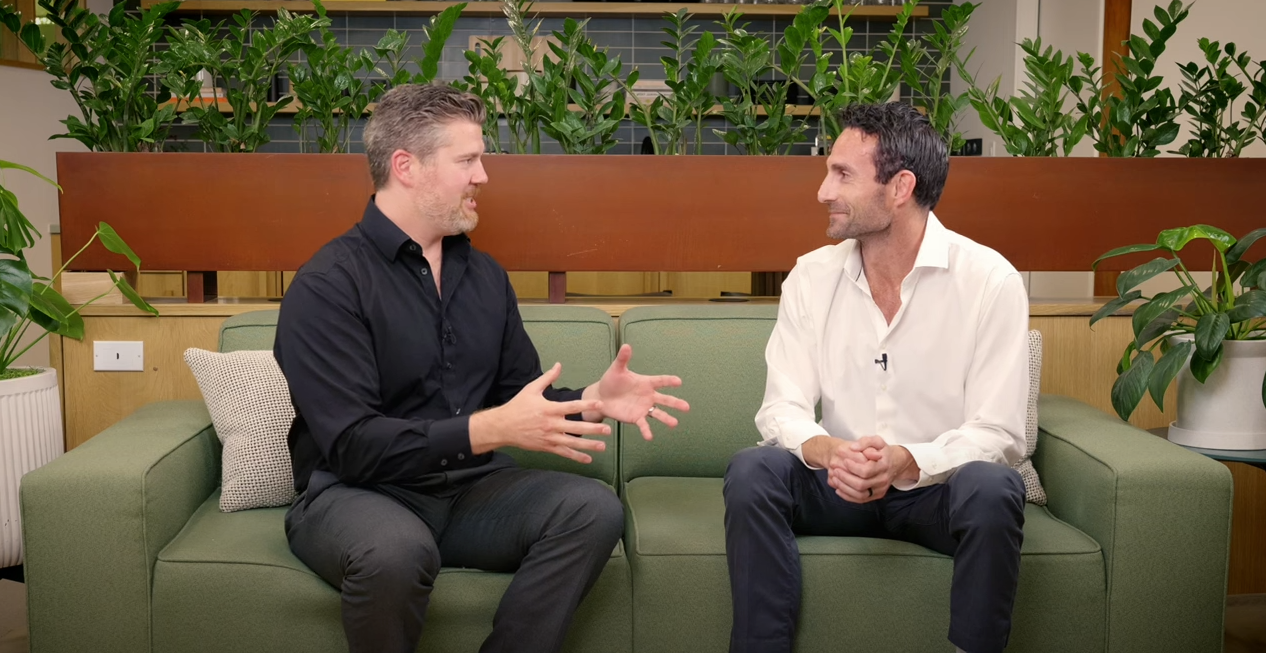
Beau Wirick: Hey, welcome to another episode of Couchside Conversations, our Modearn by Morton YouTube channel, where we're having discussions that you have around the dinner table with your own families. And today we're going to dive into some employee benefits. I know, I know. Don't jump off your seat with excitement. I got my Mike Rudow, wealth advisor with me, and I'm Beau Wirick.
And, we're going to get started with, with some questions for each other, right? Yeah. We have no idea what we're going to talk about.
This, it's usually like when I have to address these, when I take on a new job, I actually want to run away from the topic as much as possible because I'm confused. It's complicated.
Mike Rudow: And I think that's what happens. I think most people do as far as like they instead of digging into what the right decision is, they either don't make a decision or they just do what the people around them are doing. but I think, you know, out of all of the employee benefits, the first thing that people think about, is retirement planning is 401k.
And with that we have an option now of do I contribute to a traditional 401k or a Roth 401k? So maybe you want to start by empowering us with knowledge on the difference between the two.
Beau Wirick: So yeah, in the last few years, it's become a little bit more common for your employer to offer a traditional four and one K or a Roth 401 K, and so what's the difference between these two accounts? The traditional 401 K- when you make a contribution, you get a current tax write off. So if you make $100,000 a year and you contribute $10,000 to your traditional 401 K, your taxable income gets reduced from 100 to 90.
Whereas when you retire and you're able to take the money out of that account after it's been invested for all those years, then you have to pay taxes on it. So you're getting a benefit now, but you're going to eventually have to pay taxes on it in the future. With a Roth 401k, it's completely inverse. It's you have to pay taxes now on the $400,000 salary. You make a contribution to your Roth and then it grows tax free over time. And then you take the money out without paying taxes in the end. So the question is is which one do I choose? What are the different benefits. And I think the biggest question to ask yourself is, do I think I'm going to pay a higher tax bracket now or a higher tax bracket when I'm in my retirement years?
If if you're 50, 60 years old, you're in the highest earning years of your life, you're in the 50% tax bracket. If you take federal and California and put them together, it's about 50%. You're probably in the highest tax bracket that you're going to be in. It might behoove you to take the tax benefit now and pay taxes later.
But if you're younger and you think that maybe I'm in the 12 year or, 22% tax bracket, but taxes are going to go up between now and the time that I retire because of the federal debt levels, then it might be the better decision to pay the taxes. Now, contribute to your Roth 401 K and then don't pay taxes when you retire.
So hopefully that made sense.
Mike Rudow: Yeah, no, that makes a lot of sense. But do you think there any other considerations when you're thinking about whether to contribute to a Roth 410k or building a traditional 401K that that people, you know could start to think about as far as planning perspective?
Beau Wirick: Yeah. So another thing to consider is just when you have a traditional 401 K when you reach a certain age, say 73, or if you're younger then the age is now 75, the IRS requires you to start taking money out of this, so they require you to start to be taxed on it because you got the tax benefit early on.
So those are called required minimum distributions with a Roth you don't have those. So especially if you live quite a long time and you're not having to take money out of the account at age 73 or 74, 75, 76, all the way through your 90s, that money is able to grow tax free the entire time.
The other consideration is when you pass your traditional 41K or Roth 401 K to your beneficiaries, you want to think about what their tax bracket is going to be. And so if you are, say, 90 years old by the time you pass away and your and your kids are in their 50s or 60s, they might be in their highest earning years by the time they receive their the traditional 401K.
And in that case, the law says currently that they have to withdraw the entire amount over a ten year period. So you might be burdening them with a high tax burden by giving them a traditional 401K as an inheritance. With a Roth, you don't have any RMDs in your in your, retired years, and you're going to pass this to your beneficiaries, likely in their high rate, their high tax years, and they don't have to pay taxes on that even though they take it over ten years.
Mike Rudow: So that's the high-level planning that I would consider versus I mean, it sounds like if you're on the beneficiary side of it, and you're inheriting something, inheriting a Roth is much more beneficial than inheriting a traditional for one.
Beau Wirick: Hundred percent, because someone else did the work for you. Yeah. Thanks for paying the taxes.
Mike Rudow: No, I mean, that's I think those are good things to consider, right? especially if you're thinking about legacy planning and, yeah. So we went over kind of the benefits of either contributing to a traditional 401K or a Roth 401 K, maybe what the scenario is that would benefit you from doing one or the other.
Are there any other things that we should consider with the 401 K or a Roth 401K when making contributions?
Beau Wirick: Yeah. And another thing that a lot of people know, but they might have questions about is the employer match. You know, how do I get my employer match. And so usually a 401 K plan has some way that when you contribute to your 401 K, your employer is also going to contribute up to a certain amount. It can be an automatic match.
Say you don't contribute anything and your employer is just going to give you 3% of your salary no matter what. Well, they're you're going to get that regardless. Other employers are going to have you have more skin in the game. They're going to say if you contribute 1% of your salary, tier 401 K, then will match 1% of your salary.
Mike Rudow: Again, using $100,000 you put in a thousand, they put in a thousand. I call it a 100% return on investment. It's free money right out of thin air. But then that's capped at usually somewhere around 3 or 4% of your salary. If you contribute more than the maximum that they match, then there's no additional benefit with regard to them matching, there's still tax in the state planning benefits and investment benefits, but that match is usually the limits that 3 or 4% range.
Beau Wirick: Another question that I get is will they match if I contribute to a 401k and a Roth 401K? And the answer is yes, they will. And it's going to be always the match is always going to go to the traditional 401 K, because the employer is getting a write-off on it. So if you're maxing out your Roth 401 K this year, it's a $23,000 max.
Then they're going to give that match to your traditional. So it's a way of diversifying your portfolio.
Mike Rudow: If you want to start to build both buckets. Right. So that you have both accumulating as you grow in, in your career, maybe understanding what the matches for your company and contributing some to your Roth sum to your traditional for one can then getting that match in the traditional for one case. So both are continuing to grow. So it sounds like there could be some strategy with that.
And in building wealth in both buckets.
Beau Wirick: And we love it when we have clients who are approaching retirement who have IRA or traditional 41K money and Roth money, so that as they spend their investments, they can choose whether or not they're paying taxes on it. And there's a lot of strategic planning that can go.
Mike Rudow: Yeah. As far as understanding what tax bracket we're going into. And kind of controlling the tax environment as much.
Beau Wirick: As we can. Yeah. Okay. Well, I've got some questions for you because I know that you're quite the expert on, equity as compensation. And so this can take a few forms. It can be, restricted stock units. It could be non-qualified stock options, incentivize stock options, employee stock purchasing plan. Let's just cover a couple of them.
But can you just explain at a high level what's an RSU or restricted stock unit. And how do you get paid and how you get taxed.
Mike Rudow: Yeah, I think I think a lot of young people in today's working environment are getting more than salaries, right? They're getting paid as, equity as compensation. And understanding the differences between these things and how to plan around them is important, when a lot of times they really don't know what they're receiving. So when you think of an RSU or restricted stock unit, that is essentially them paying you salary in the form of shares of stock, right?
And a lot of times how that happens is they'll give you, a vesting schedule with a certain amount of shares. So say I have a four-year vesting schedule and 1000 shares in year one. I'm going to be awarded 250 shares of my company stock in year two, another 250 shares in year three, another 215. And your form that last 250.
Beau Wirick: And hopefully you're working for Nvidia right.
Mike Rudow: And based on the fair market value of the share price, when I'm awarded that stock, that's essentially how much salary I'm getting. So if I have 250 shares and the stock is worth $20, I am receiving that as salary. So that is taxable income. I'm going to pay payroll taxes, Medicare, Social Security, taxes on that. and what I have to plan for is I have the option now of either holding that stock or when that stock best I can sell that stock and create income for myself.
Either way, it is being taxed.
Beau Wirick: So if you sell it right away when it vests, it's almost it's the exact same thing as if you just received it in salary.
Mike Rudow: Exactly. Because what they'll do is they'll withhold either the amount of shares, to, to cover your withholding tax, or they're going to take withholding from the actual salary that they pay you. or they're going to sell those shares to then create the money to create withholding for you from the tax perspective. So it's no different then you're receiving salary.
You're just receiving it in the form of shares.
Beau Wirick: I could take salary and just go buy the stock in my brokerage account. And it would almost be it would be the exact same result.
Mike Rudow: It would essentially be the right. Yeah.
So then what is the benefit of not selling it right away. What happens?
Mike Rudow: The consideration is now you have equity in the company. And if you think that you're company is, you know, is going to continue to appreciate. Right. The company's growing. Its doing well. you now have the opportunity to grow those shares. Right. So it's a way to accumulate more wealth. where the risk comes in is, is concentration risk right.
How much equity do you have in your company and and how much risk is that presenting, to you and your overall financial plan? So, you know, when you're considering that what I always ask people is like, well, should I keep my RSU in stock or should I convert it to cash? It's like, well, if you got paid that money in cash, would you turn around and buy that stock?
Question. And if the answer is, well, yeah, I love my company. I believe in my company. I think we're going to continue to, to do well. I don't own that much. already. Well then maybe the answer is let's keep those shares and let those grow. if they already have a large concentration, of that company's stock, let's identify the risks there.
Right. And so I usually tell people like, look at your overall net worth, right of, of your investable assets. And if your position in your company is over 10%, there better be good reason that you're holding more of that stock and you better more importantly, you should understand the risk that you're taking on by holding that large of a concentration.
Because not only is that a large part of your investable net worth, that's also where your salary is coming from. So if something were to happen to this company where they're doing layoffs and maybe you're one of those layoffs, well, most likely if they're doing layoffs because the company is not performing well, the stock value is going to go down.
You just lost your income. That's a lot of risk, all based on when companies.
Beau Wirick: And when you lose your income. And then you have to you're forced to go sell that stock. And it might be forced to sell to depress value. Yeah. We just saw this week we're filming this in a week that Salesforce just reported earnings. And you know, not bad earnings. But it wasn't what people were expecting for future growth.
And the stock was down 20% in a day. Right. Great company. And to think if I had say 50% of my entire net worth in, in that company and it lost 20%, well, I just, I just lost a big amount of my net worth in one day. And what if I'm getting laid off at the same time?
So that's the kind of conversation that we like to have with clients about, you know, mitigating that type of exposure.
Mike Rudow: Yeah, absolutely. And then another form of equity is compensation, which is different is a non-qualified stock option. and with the non-qualified stock option you are not receiving shares, you are receiving the right to purchase shares. And how that works is you're going to have basically you're granted, the rights to purchase a number of shares. And when you're granted those, you're going to have a vesting schedule similar, similar to an RSU where you might be granted a thousand shares or four years.
So they vest 250, you know, every year. when your initial tranche of shares vest now, there's going to be a grant price that they granted you those shares that so say those 250 shares vest and they granted you those shares at $30 a share. Well, you might go looking when those vest and you have the availability to purchase the shares.
The fair market value of that stock might be $60 a share.
Beau Wirick: So if I went just on the open market through my brokerage account and bought a share, I would have to pay $60. But since I have a non-qualified stock option, I'm only going to have to pay $30 to acquire the shares.
Mike Rudow: Because that's what it was granted to me. Right? So from there, you've got a gap between 30 and $60. Now, if you decide to exercise your right to those options and purchase those shares, that gap between 30 and $60 is considered ordinary income. So you're going to pay ordinary income tax on that delta right. now, if you then sell the shares right away, there's no extended tax on that.
Right. Because you bought it at a valuation, you sold it at that valuation. So your only tax liability is going to be that ordinary income of that delta. Now if you decide to buy and hold those shares and then you hold it, anything above that would either be short-term or long term capital gains, depending on how long you held it.
If you saw that before a year, then it's going to be short term capital gain. If you wait a year longer than it's going be a long term capital gain.
Beau Wirick: So anything the difference between what I paid for it and what I would have to pay for it if it weren't an option that gets taxes. Ordinary income, and then I hold the stock for less than a year. And if it gains anything from that, from that starting point, that's going to be ordinary income. But if I hold it for more than a year and it's going to be long term capital gains on on the growth of the stock from the time I acquired it sounds pretty complicated, Mike.
Mike Rudow: It's I mean, it's important to understand the end, but also because there's a lot more that goes to it because once once it vests, you don't have to exercise that. You have usually up to ten years to exercise your vested shares. So if you if you're your options vest and you're not in the money, if the fair market value of the stock is lower than the grant value, right, you're not going to want to exercise those shares.
So you're going to want to sit back and wait until it's a favorable time to buy in. But there's also tax considerations because like we just talked about that's ordinary income. So if you're making a lot of income already and now you're vesting shares that might push you into a higher tax bracket. Right. And you might pay more tax on those shares than you considered.
So a lot of times what happens is then you sell enough shares to cover the taxes for that. And what you actually end up netting might be less than you thought. So it's important to understand all of the different variables that go into exercising these shares. And when the right time is right to to start exercising and knowing that the shares are in the money.
Beau Wirick: And I think that's why we're having this conversation, because this is a great time to pick up the phone and call Mike. Or do you call your financial advisor and talk through your options? Yeah, exactly.
Mike Rudow: I mean, most of these, these employees of these firms who are getting they're busy with the actual job that they have, and they might have a high level education on what's offered to them. But there's a lot of different variables that they need to consider. So, approaching your financial advisor, having those conversations, understanding what's available to you, I think is really important.
So let's do a, a lightning round for these last two. And when I think of lightning, I think the first thing that comes to mind is a health savings account. Right. Because naturally.
Beau Wirick: If I get struck by lightning, I might have to pay some out-of-pocket medical expenses. So HSA is get a lot of questions on these. And the complexity with an HSA is that from a tax planning perspective, it's one of it's like the golden goose of tax planning. And the reason is, is because you get a deduction when you put money into it.
So it actually reduces your taxable income. All of the money that you invest within an HSA grows tax-free. And then when you take the money out to use to pay either current or past medical expenses, once you're in retirement years, you don't get taxed on that money as long as it's used for a qualified medical expense. So that's a triple tax benefit, which as financial advisors, we flip out about.
Mike Rudow: We're so excited about this. However, there's a couple of things to consider. If you're going to qualify for it. You have to be enrolled in a high deductible health plan that qualifies for an HSA in order to be to qualify for it. So what that means is, is that the deductible that you pay on your medical bills, if you're a family, can be, $3,200, a minimum of $3,200.
So, for instance, I used to, when I was an actor, I had the Screen Actors Guild, health insurance, which is just wonderful. My deductible was $100. I would never go from that. and take from that to get a $3,200 deductible just to enroll for an HSA. But now that I don't have that, as long as I'm not going to the doctor a lot and I don't have a lot of medical bills, it might make sense to save on taxes because I'm not going to have those savings offset by higher out-of-pocket medical expenses.
Beau Wirick: High level. It's usually beneficial to do an HSA if you don't go to the doctor a lot. Know, and if you go to the doctor a lot, it's probably not the best idea. But you could do some analysis with your financial advisor to see if it's a good.
Mike Rudow: Idea for you. And just to understand that as an option, because I think most people don't even know that that options available to them in if they have it available, they don't really know what the benefit right of it could be. and I think one consideration is like a lot of people are looking to put away as much tax deferred income as possible.
Right. They're looking to build up those, those, tax deferred savings accounts for the future. And if they're maxing out their, their current 401 K and they don't have the ability to, you know, defer any more income, this is another bucket that they could start to fill. And it can start to grow to be something considerable in the future.
And like you said, in the future, when they're at retirement age, they could reimburse themselves for for medical expenses and pull that out and not having to pay any taxes on that when they didn't pay any taxes on it going in. Right. That's that's pretty incredible. You don't have any other account like that.
Beau Wirick: No, it's the only one. But yeah, keep your receipts.
Mike Rudow: Keep your receipts. Right.
Beau Wirick: The moral of this story. Right. Okay. Last, Lightning Round, we want to talk about the most fun topic, which is death and disability.
Mike Rudow: Oh, I love that. Yeah, yeah. So I mean, I talk about it every day.
Beau Wirick: Well, you must be a really. Okay, so your employer oftentimes will give you a life insurance policy option a disability policy option. What are some of the considerations that you should think about as an employee before enrolling in those.
Mike Rudow: Yeah. Like everything every every situation is different, right? It all depends on who you are, what your family needs are, how many dependents you have, how important is your income to your dependents. but I think the first consideration is understanding that if you are, on a policy that your employer is providing, know who's paying for that policy, right?
Because if it's your employer who's paying for the policy for to protect you, well, then any of the benefits that are coming to you are going to be taxable. So if it's a life insurance policy to your beneficiaries that the employer is paying and you pass away, that is considered taxable income to your beneficiaries. If it's a disability policy that's going to replace some of your income, if you have a disability event that your employer is covering, that's going to be taxable income to you.
Whereas if you're taking it from your pocket and paying for those policies, right, that is going to be tax free income to you. If it's a disability policy or it's going to be tax free, lump sum to your beneficiaries. if, if something were to happen.
Beau Wirick: It's pretty interesting to think about, you know, you pay, let's call it $50 a month into your insurance policy. But if you end up using it, the benefits that you get are in the tens or hundreds of thousands of dollars, tax free or not tax free. That's a pretty big change.
Mike Rudow: Especially with the taxes. Yeah, that we have now. Yeah. another consideration too is portability, right. If if you're with an employer and you're on a group policy and God forbid something happens that you leave that company, you get fired, you get like, oh, you might not be protected anymore because that plan might not be portable. You might not be able to bring your insurance with you.
So you're leaving yourself exposed. Whereas if you have a private policy, one that you, you know, purchased from a provider yourself, doesn't matter.
Beau Wirick: Working for, you are protecting yourself. And that can go with you anyway. So I think it's important to plan to understand, okay, how important is one my income to my family? Do I have a spouse that has an income that could cover our non-discretionary spending? if I do, then maybe disability is not as important. If I don't.
Mike Rudow: Disability insurance is very important to make sure my family is protected right from a life insurance policy. Take a look at your liabilities, right? If you have, a spouse and children and you have a large mortgage, you might want to have a large, insurance policy that would be able to pay off that mortgage so that, you know, that's less stress on on your spouse if something were to happen to you and that you no longer have that income, her bills or, or his bills are much less, are what are your kids age?
Are they going to be going to college soon? What does it cost to, you know, for for their quality of living? every year. And so, so understanding what an insurance policy would need to look like to be able to address those things. Yeah.
Beau Wirick: Find that magic number of what would I need to replace my income if something happened to me. Right. in order to take care of my family. And from there, you can look at your options and see is what my employer is offering me. Is that enough, or do I need to supplement it with something outside? Is it too expensive to go through my employer?
Would it be cheaper to go outside or vice versa?
Mike Rudow: Exactly. So understand what your options are through your employer and then be able to supplement that with personal plans. Yeah. but yeah, I think I think the more we know the better position we're in. Right. And so taking some time to plan that out to identify what your options are, to identify what your needs are outside of that, and then pulling together, a plan to, to make sure that your, your cover.
Beau Wirick: The plan is pick up the phone and call micro debt. Obviously as we've established right.
I as always, we like to end these conversations with a this or that round where, you know, we've talked about high level, but now you have to answer from your personal perspective, Mike. So you know, you can't outsource your yeah. You can't hide from this. All right. So first question Roth or traditional for one guy.
Mike Rudow: That's a hard one because I'm, I'm let's do both. So but but if I had to pick one. Yeah, I would say Roth. And the reason I'd say Roth is look, look at look at the environment we're in, the amount of debt we have as a country and the deficit that we're spending. I don't think taxes are going to go down in the future.
I think, if anything, they probably have a good probability of going up.
Beau Wirick: Yeah.
Mike Rudow: So if I can one have the ability to put away money that eventually is going to be nontaxable when I pull it out. And if my kids inherit it, they're going to have a much better account to inherit than a traditional IRA. That's great. And two, I think that, because taxes are going up, I would rather pay the taxes now than eventually pay them when.
Beau Wirick: It hurts, though. I mean, we live in California. We have to pay for it.
Mike Rudow: That's why that's why I started with I would do both, but if I have to pick one, I think with the direction that I think taxes are going, I would I would go with the Roth.
Beau Wirick: Okay. Well said.
Now for you. High deductible health plan with an HSA or low deductible health plan. No HSA.
Beau Wirick: I am, I'm so conflicted on this right now. I'm using a high deductible plan with an HSA, and I'm considering quitting because I'm doing the math. And, I think, you know, I go to the doctor for I see a mark on my arm, but I. What is this?
Mike Rudow: What is this? I was going doctor in 14 years, but.
Beau Wirick: Yeah. So if I were in your shoes. Easy. But for me, I think I just have too much of a relationship with the medical industry to, to justify the cost at this point. So I think I'm going I think I'm going to go off that high deductible health plan. So. Okay, final question for you. Would you rather have your employer worry about all of your benefits, or would you rather take care of it yourself?
Mike Rudow: I'm in the boat of of take control of things that you can and that means I'm going to take care of it myself. I want to identify what my family needs. If I were gone, and I want to make sure that I have those policies in place, regardless of whom we're working for. Yeah. And anything that I get through my employer, I look at as a bonus, right.
I think that that is extra benefit that my family can have if something were to happen to me, or if it's an extra benefit that me and my family can have. If it is a disability event that, that just means I need to replace income.