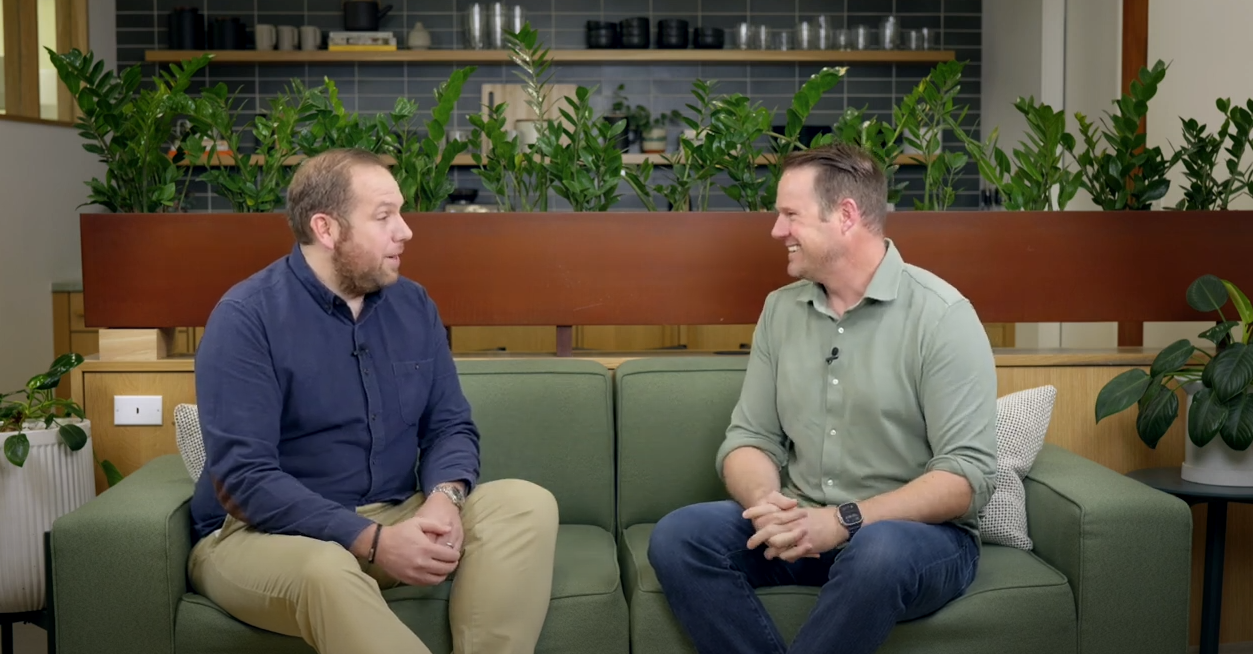
Kevin Rex: Welcome to Couch Side Conversations. I'm Kevin Rex and my colleague Jon Wingent here. We're Modearn by Morton. And we're going to talk about something that's top of mind for a lot of our friends and colleagues, that are modern clients. And that's buying real estate, rental properties, homes. And those are all different concepts. But the one thing that remains the same is interest rates are driving fear or, you know, manipulating how we feel.
So I'm going to kick it off to you by saying, do you jump into the market when interest rates are high, or do you try to wait for a more opportune time?
Jon Wingent: Well, Kevin, your question- are interest rates high? Everything's got context. Interest rates might seem high in context because we've been used to a period of very low interest rates.
Older people are saying, well we had mortgages that, you know, double digit percentage, some 15%. So by comparison, actually those rates don't seem high. But the economic environment is going to do what it's going to do. And, you've got to think about what actually your purpose is, is buying a home. And that might be a home that you're looking to buy as your main residence.
It's a huge emotional decision. Yeah. So letting factors like interest rate drive that. The other thing about mortgages is that, if you're taking a mortgage out, you're buying into a 30 year rate. You can always refinance that, those rates are going to change over time.
Kevin Rex: Yeah I always talk about you kind of you marry the home, that's long term. But you date the mortgage. So there are potential opportunities whether it's one year, three years, five years down the road to reduce that rate. And I know you and I talked a lot about this, but can you afford it right. Is it a home that you want?
If it's a home that you love and you want to be in and you can afford that mortgage, I wouldn't let it steer you away. I would say jump in and and then hope that sooner rather than later you're able to refinance and brings it down. But you have to be able to afford it, and it has to be a home that you're willing to, to spend on.
Jon Wingent: Yeah, absolutely. I mean, affordability is everything you've got to think about- that's going to be your biggest monthly commitment, right? Your mortgage and those again come back to the rates. You know, the rates are going to determine what you're paying on a, on a monthly basis. You know, your refinance thing, you're working out if that's something that you can accommodate within your current cash flow, you know, is that something that you can afford?
You're likely to have had to put down a down payment as well, you know, so and that's typically 30% of the property value. So affordability is absolutely key. But again don't necessarily let these factors influence your decision. If you find somewhere that you love. Yes, it's got to be affordable. But if you're finding somebody that you love and you have that feeling you know.
Kevin Rex: What is affordability? So when you're advising clients and you think about, okay, I make $10,000 a month, how much of that monthly take home should be going towards my mortgage or living costs? Do you have guidance on that?
Jon Wingent: Yeah. Well, typically you'd consider about 30% of your monthly take home to go towards a mortgage payment.
Kevin Rex: Yeah I agree with you. And then of course this all depends. Everyone's got a different situation right. If you're someone that travels or eats out all the time, maybe you have a little bit less to spend on your home, or somebody who eats at home and spends a lot of time at home. Maybe you can increase it, but I think 30% is a really good guideline.
Jon Wingent: Absolutely. I mean, circumstances always, dictate, you know, I remember when, Julia and I were shopping around to buy a property, we moved over here from the UK and we were looking at the time when interest rates were starting to increase. And it's difficult I mean, despite our saying don't let it dictate.
I mean I was advisor and I still was, you know, felt that kind of interest rate pressure coming down that I knew that the rates were being, and in a rising environment, quite aggressively as well, compared to a historical time. So, you know, your 30 year rate could change quite quickly. So there was that added pressure.
And there's also the competitive nature of the market. So when interest rates are higher, you get less supply in the market because those that are already in a property, they might get 2 or 3% interest rates. If they don't need to move, they're going to be unlikely to move, you know. So if they don't need to. But the market dynamics of real estate, you know, you have buyers like me and my family- we had to buy. It wasn't because we wanted to upsize.
You know, we had to buy. And there's always those buyers in the market. The sellers in the market don't necessarily need to move. Sometimes you do need to move. If you get a job across the country and you're moving. But typically that does weigh on supply. And that has been an issue of late is the supply it makes.
There's less coming to the market and then there's more competition when you're actually looking to buy.
Kevin Rex: Yeah, that's a great point because I actually would think rates are higher, less people are looking to buy. But I didn't think that it's creating less of a supply because people aren't moving. And that's actually a really good point to think through. So when you're looking for a home, I actually think of it a lot like dating, right?
You're going and checking out a lot of different places. And what I like to think about is when you're dating, there's like non-negotiables. There's like five things that they have to have. And of course there's other things that you want to have, but you know, you can live without. And again, with buying a home, it's very similar.
What was your experience like? What are some of those things that you feel like okay, make sure this works. You know the lights or the paint color, we can change those out.
Jon Wingent: Yeah. And I guess like dating when you walk into that home that you fall in love with you, kind of, you know, it's a feeling and, and, you know, and there are things that, you know, you, you're going to have to make compromises on in your own mind. And I think from the experience that I've had having bought real estate before, not in the, not here in the US, that was a first time experience, but I had the benefit of buying real estate before.
And what I've experienced is you're always going to want to put your own stamp on that. And you mentioned, you know, a lick of paint. That's something fairly easy to do. Don't get distracted. And if you see scuffs on the walls or bad light fixtures, you know, that's something actually that can be really easily fixed. But non-negotiables, it might be things like substantial work that you might need to do.
And in my experience, that's typically kitchens and bathrooms. You know, you're going to want to put your own mark on that. So you're going to want to have a kitchen and a bathroom that you love. And that's like I say, it's a big cost. In this environment where interest rates have actually been higher and inflation has been higher, you know, that cost, you might not actually fully appreciate how much cost that will take.
I mean, it could be $10,000 for a bathroom two years ago, now that might have doubled, because of the cost of materials or goods, labor. So that's definitely something that I would would give as a, as a tip, you know, have a look at that. For me, those were all non-negotiables, the kitchens and the bathrooms.
Kevin Rex: Sticking with kind of the dating thing. Right. Like you walk in and everything's staged. It's like first date. You had your hair, your makeup, your, you know, we have our best shirts on. So you're kind of putting your best foot forward. So I always like, you talk about kind of making sure that you're looking at it at different times.
What's kind of your suggestion around checking everything out, not just seeing it on the staged day?
Jon Wingent: Absolutely everything is staged. So, from the moment that you've seen it on Zillow or Redfin, you know, with the glossy pictures and making rooms that bigger than they perhaps, are.
Then when you do go and see the actual property itself, typically that might be an open day, you know, like all the other prospective buyers see you there. And they can be quite busy. And the balloons are outside saying, come on in. Everything's staged nicely.
So they don't necessarily need to sell you falling in love with a property, but it is staged and it's not how it's going to be when you're, when you're living there. So I would recommend that you look around, for example, the neighborhood that you're going to be in. Look at the exterior at a time when there's not the open house and lots of people and distractions.
Is it on a busy is it on a busy street? What's it going to be like during rush hour? Go during rush hour. Take a look at the yard. Can you see around the yard? Are there a bunch of ADU units at the back of your yard? Is that going to be an issue?
Just check there's not a sheet at the back of the garden sort of covering something. But absolutely have a look at that on the exterior. And then as you walk in, you know, that's where the things like the non-negotiable is the bathrooms, the kitchens, you know, pay attention to the interior and what, what work you might need to do, if any.
Kevin Rex: Yeah, that makes sense. Jumping to another question, I think that we get a lot of and it kind of goes off the interest rate thing is we have buyers, we have friends that are like, I can't find my dream home. I'm just going to rent. Do you suggest saying, okay, wait for your dream home & rent now, or is there a time or a place where you say, just buy what you can, knowing it's not your forever home, but at least you're in the market?
What are your thoughts on renting versus just getting into the market?
Jon Wingent: Yeah, I mean it's tough, isn't it? You know, you can find your dream home, but you can be up against a lot of competition. I remember when we sold our place in London, you know, we lived in the middle of a city, you know, real estate prices quite high, moving to a suburban area. So typically similar to, say, if we'd lived in LA and we were moving to the suburban area here, Thousand Oaks area, I think you've got a lot of capital there to invest in suburban real estate.
You know, you think that actually you're a pretty good buyer, but you're up against other buyers that might be moving from a city or, you know, have have the cash to buy. And we talked a little bit earlier on about supply. So there might be a bit of forced renting there where actually you do want to... your intent is to buy a forever home.
So perhaps renting is an option to do that.
Kevin Rex: You think about learning the area. So COVID as you mentioned, people are moving from cities because their home became more important during that time. And they wanted space. They wanted land. So you have inner city people moving out, driving up the demand. But I also think when you live in the city, oftentimes the wealthier individuals are paying for private schools and you move out to an area like where we live and work, schools are really good.
And now you have that monthly money that you are putting towards schools that can go towards your home. So that drives up competition and what people are willing to bid or pay for homes as well. So yeah, that demand is high.
Jon Wingent: You know. Absolutely. I mean, you touched on a point there. I mean, the renting, it might be that your forever home is in that neighborhood, that area. So if you're renting, you know, you've got kids, for example, you want to then put them in school, you know, you're getting them into school. You're establishing yourself in that community, through renting.
So there's definitely a place for that with renting where I've always found it difficult. And I'll be interested to hear your take. You know, you own some, some rental property yourself is that rents right now are similar to mortgages. You know, you're almost paying the same in rent right now that you're paying with a mortgage.
But with the rent, of course, you're not getting equity in that asset yourself. The equity is going to the landlord, you know, in that instance. So I'll be interested to think, to hear what your, take is on that.
Kevin Rex: I agree completely. It used to be you rent for a lower cost so you can build up and save for a down payment. That's not the case anymore. Rents are oftentimes more than the mortgage. And so it's it... I find that a lot of my friends, they make enough money to pay that monthly amount, but they don't make enough to save for the down payment.
So renting oftentimes is the only option for those that have a down payment and can get in the market. If you know where you want to be, the location long-term, it doesn't have to be the home long term. I'm a big proponent of buying into that market. So that way you now have an asset that's going to fluctuate with the other homes that are eventually going to be your dream home.
So if prices fall, yes, you lose money on your current home, but the house you're buying probably is going down in price and vice versa. If prices go up, it allows you to participate in that going up, renting versus buying a couple things. So now you buy, you're taking care of the roof. You're taking care of any air conditioning units or leaks or things that may occur where renting, you still just have the benefit of kind of calling the individual saying, all right, hey, your landlord and saying, hey, my, my light bulbs are broken.
It is not fun as the landlord. And even though you know we do have property managers, it still creates a lot of work. And so another question is, okay, I don't want to buy just to get in the market. I am going to rent. Do I take my downpayment and buy a rental property? Yeah, the answer is yes or no. I mean it depends obviously on a situation.
The one thing I would say going in eyes wide open is it's not passive. It is not, how to buy this property. And rent checks are just going to come in on a regular basis, and I don't have to worry about it. There are quite a bit of headaches if things go vacant, whether it's an individual property or multi-unit, there's potentially a cost that falls on you.
And so I do like rental properties and, you know, real estate is one of our favorite asset classes from an investment standpoint. So I do believe in people owning real estate. I would say focus on getting your primary home or residence for most people, first. That, you know, once you have that and have established yourself building your real estate portfolio after that.
So I think kind of in summary, when you think through what we've talked about, interest rates are high for the modern client. Maybe not our parents. Don't let that scare you away. I think we would tell our friends and colleagues, look, if you can afford a home, even though the monthly payment might be higher than you like today.
But if you find that dream home and you can, you can make that payment, we would say go for it. you can always refinance in the future. another thing to and we talked a lot about competition today. You want to be the best buyer you can be.
So a seller's looking at multiple applications. We think that usually the highest price wins. That's not the case. I know you've sold real estate. You're looking for the buyer that's going to be able to close easy, smoothly with no issues or headaches. So don't just get pre-qualified, get pre-approved. You want to walk in and say, I'm Jon, here's what I have.
Yeah. Here's what I have. Here's my down payment. You want it to be clean with a bow on it.
Jon Wingent: You're so right. Kevin, I'll add a tip to that. Find a great buying agent. We were fortunate to work with a really great agent that knew, you know, how to position us as buyers, how to position us as those good buyers.
And, you know, one thing that going into the process that I was not familiar with and a tip I'd give to any prospective buyer is get your, finances in order at least three months ahead of getting pre-approved. And then when you are approved, you know, they're really going to go into a lot of detail on your monthly expenditure.
You know, how much is your mortgage going to be, say your mortgage is $3,000 a month, and it's just like take any number. if you've had a $3,000 credit card bill that month, they're going to ask, you know, where's that coming from. And look at their... they want to look at the money trail. So you know getting that all in order.
Don't make any big purchases on a credit card three months ahead of looking for an approval. You know, little trip tips and tricks like that are really, really important in a competitive marketplace.
Kevin Rex: It absolutely is. It's always amazing to me how this is the biggest purchase most of us will ever make. And you do make it quickly. So once that process starts, you find the home you make, your offer gets accepted. And we're talking 30, 60 days. So because that's fast, the more prep work- driving neighborhoods, understanding schools, talking to friends or colleagues around you know, where you want to be and where you want to establish yourself long term.
The more work you can do up front, probably the smoother process and the agent is key. So I'm glad you brought that up.
All right. And now we're going to play a little game. We've done this in the past. Jon and I both have questions that we've prepared, that we have, we don't have prepared responses for. So we're going to call this this or that, and I'm going to fire away the first question. So for you, it's like the love it or leave it.
Would you rather stay in the home you have or move to a new home?
Jon Wingent: Yeah. Good question. Well, I spoke about falling in love with a home and a forever home. And my most recent experience is buying a home that I feel is a forever home. So, I would be... love it. I would, I would stick where I am, if it needs some renovation, I do some work. You know, for me, it's about staying where you are, so I'd be love it.
Kevin Rex: It has your non-negotiables.
Jon Wingent: So for you, Kevin, what I was thinking about, you know, as a landlord, would you rather have a longer-term tenant, rental tenant, or would you rather rent it out as an Airbnb?
Kevin Rex: Airbnb. You make more money typically, right? I think the short term rentals you can charge a premium for. The headache of having to turn it over.... even if people are dealing with those headaches. You think about the wear and tear on the property. I think I would opt for a really solid long-term tenant that I just didn't have to think as much about, didn't have to worry as much about, even if it meant a little bit less on the income side of things.
Jon Wingent: I'm about just ease and and having a nicer process. So I think I would go towards long-term tenant if it was the right tenant.
Kevin Rex: So back at you, I think that, you know, would you rather this or that, build your dream home or buy a home that's already built.
Jon Wingent: Yeah, that's a tricky one because buying your dream home, you know, you can absolutely put your mark on that. That's more than a kitchen and the bathroom. You can do it how you want to do it. For me, that's more about what the stage you are in your life. So, you know, I have a young family, two working parents, I think, to build a home right now... we just couldn't take that on. But I like the idea of building your own home. And of course, we have clients that are in that position where I think of it, it's like a dream that you can have in retirement. You build your own place.
So, you know, something to consider as well when you're looking around is, is and we talked about looking in the neighborhood. You know, another thing, particularly here in California is things like insurances. Think about what, if there might be any kind of insurance, issues.
So if you had to pick between home that had earthquake damage or flood damage, which one would you go for?
Kevin Rex: I believe that water damage is the worst, and so I would have avoided at all costs. So I'm going to lean towards earthquake damage on this one. I've just, I've had water damage. I've heard from others where water is going to find every crack and cranny, and then issues pop up later with mold and all kinds of things.
So, I would rather have earthquake damage. And then talking about insurance, the thing to consider is water damage isn't covered if it's from outside water, right? A pipe burst inside covered, but oftentimes, you know, whether it's a flood or nowadays, the insurance companies are always arguing to fight that those pipes are outside the foundation. And so I just find that to be an incredible headache.
Thank you for joining us. We hope to see you again. Please subscribe to our channel. Follow us on Instagram.