January 2026
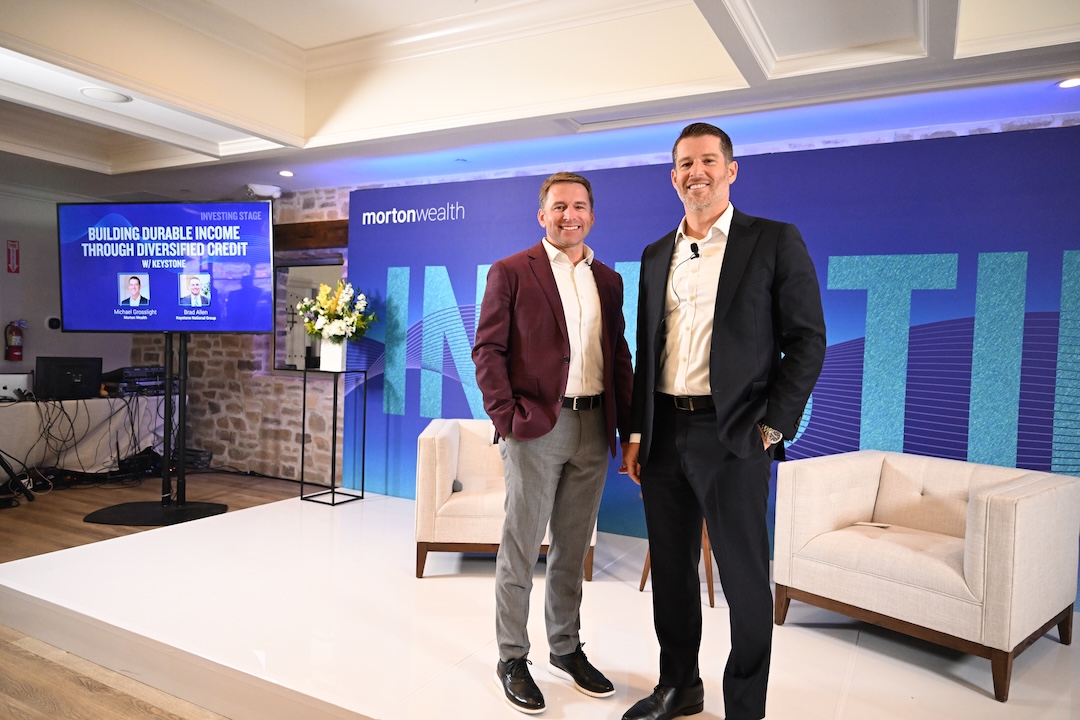
At our 2025 Investor Symposium, Michael Grosslight sat down with Brad Allen, Managing Partner of Keystone National Group, to unpack what it really means to build durable income through asset-backed lending. Brad explains how Keystone focuses on tangible collateral—like equipment, inventory, and real estate—to generate consistent income while prioritizing downside protection in uncertain markets.
Tune in if you’re interested in…
Watch previous episodes:
Ep. 168 Generating Income Through Real Estate Lending
Ep. 167 Targeting Opportunities in Essential Housing Investments
All right. We'll go ahead and get started. Thank you, everyone, for being here today. My name is Michael Grosslight with Morton Wealth. I am thrilled to be joined on stage by Brad Allen, managing partner of Keystone National Group. And we're going to be discussing one of Morton's favorite strategies, which is, building durable income by investing in asset-backed loans.
So these are loans backed by tangible assets. So, I am personally excited about this session. I am invested in Keystone Income Fund myself. So I plan to really ask Brad some difficult questions. Make sure he's protecting my investment. But Keystone does a great job for anyone that is invested with them. I'm sure you are aware of their performance and just the way they manage the strategy.
Before we get into some of the questions, that I'll be asking Brad, I do want to give a quick overview of, of what Keystone does for those that maybe aren't as familiar and why we're excited to, to partner with them. So to high level, Keystone specializes in asset-backed lending opportunities. So, the goal is to produce current income and protect and to protect in downside scenarios.
So we're going to talk through, you know, some examples of what those investments look like. But one of the reasons we really like them at Morton is, you know, one of our investment tenants is diversification. And Keystone does a great job of diversifying across different types of loans from equipment leasing, real estate finance, corporate finance and other real estate assets.
Keystone has been around for some time. There were founded in two thousand six. So they've seen some interesting markets between the financial crisis, the pandemic, more and started investing with Keystone just about four years ago in early two thousand twenty-two. They'll leave anything out. And you want to add Brad?
You got it. Yeah.
All right. Let's get into the questions. So let's start. I think it'd be helpful to give the audience an idea of how the team evaluates potential lending opportunities.
Yeah, and this will be a little bit different than some of the strategies you've heard as, Michael mentioned, where asset based lenders. And so we're looking primarily at collateral. A lot of what you observe in mainstream private credit has been mentioned before, is going to be financing in LBO, you know, a private equity company coming in wanting to buy some business, evaluating how much revenue does this company earn?
How much EBITDA, much cash flow. And then Apollo or Blackstone or KKR. You know, they all kind of do the same thing or come in and finance that. Very different. You know, than the approach we take. Our, our position is there are plenty of places to go if you need to finance in LBO. We want to identify opportunities that, you know, a business has need for short term capital.
So we're not trying to be anybody's long term lending partner for the next seven years. It's a very efficient market to do that. You don't need one more player. But there's lots of situations that we find, you know, all across the country. You know, where our focus has been of companies who just have an opportunity to acquire some assets and they want to finance that.
They want to do it for just a couple of years, and they're willing to pay a premium if you can help solve that cfo's problem. And so the first indication, of course, you know, an investment opportunity comes in and we have an in-house team that is all day, every day scouring the country for these types of opportunities. But the first question they've got to ask is what is the collateral?
Because that can be a bit of a, you know, gray fuzzy line we see with especially the launch of a lot of new asset based lending funds. That are coming out there. Blackstone just launched one Blue owl just launched one. And, asset can be defined, you know, very, very loosely, let's say. We typically invest across four different asset classes, equipment, manifesto, manufacturing equipment being kind of our primary target.
So think of a business you know, that as manufacturing line needs some robotic equipment. Fleets of trucks, trailers. You know, caterpillar. Gensets. We really like, that would be kind of one category. So if it checks that box, great. It's going to get through, you know, the initial screening, real estate being a second category for us. Financial assets, a third category for us.
So this would be situations where you do have a bona fide asset. You just can't touch it. So think of receivables. We do some nav lending, so family offices and private equity funds, they want to borrow themselves. They have assets. You can't touch them. But there's something to pledge there. We'll lend against that. And then the fourth scenario for us is going to be a bit of a catchall general corporate lending.
This would be situations where you've got a business again, they own, you know, some trucks, trailers, equipment, you know, something and are looking for a whole, first line senior secured kind of whole balance sheet, option for us. So that's going to be the first category we're looking at is what are the assets. And then there's a heavy underwrite.
We've got special teams with specialties. We call them centers of excellence. So the team that's underwriting and equipment leasing transaction is not going to underwrite a real estate transactions. A different skill set, same on the financial asset side. But yeah, we're really looking at, you know, what is the asset. Is it going to hold value. And then trying to solve for you know any asset is going to depreciate you know over some period of time meaning it's going to get worth less and less the more you use it.
And we just have to make sure that our investment is structured so that we're getting paid out, you know, extremely quicker than that depreciation curve. So there's a lot of, you know, financial analysis that goes into that a lot of heavy legal lifting to understand, gosh, heaven forbid, if we had to go in and foreclose or take over this asset and sell it.
What does that process look like? You know, we don't want to have that happen, but we've got to make sure, that we're protected. If that situation comes up and then, you know, it's been mentioned before with in private credit, there's a lot of customization for these deals. So, you know, it's maybe one nuance that you think, okay, hire your law firm.
You know, just give me kind of a standard template loan agreement. And that doesn't really work in our business. You know, that manufacturing equipment is going to be very different. You know, the deal is going to be very structured, very different than, say, the real estate one or the financial assets one. And even within manufacturing equipment, depending on the type of collateral type of business, you know, these are very heavily negotiated.
So there's a lot of work that goes into take everything we learned in due diligence and package it, customize it for this borrower, so that they can get the capital they need and we can get the, you know, piece of mind that we need, knowing that your investment is safe and my investment is safe, you know, in the, in the fund.
And thankfully, you know, we I think we've done a really good job doing that over the last five, six, seven, eight years.
Great. Can you give us some more specifics around a recent investment, like what was the type of collateral? Just talk a little bit about a specific example.
Yeah. Yeah. So we we look at a lot of transactions and we do a lot of transactions. So as I mentioned, our focus is being a shorter duration lender. So on average within twenty-four to thirty-six months we want to be out of every deal. Some you know we're comfortable to go long. Some are going to be quicker than that.
But you can imagine you know, the funds about two billion right now. Turning that over, you know, every couple of years requires a lot of a lot of deals. So we look at a lot of deals closed, a lot of deals. Gosh, just in the last couple of months, you know, we finance a business that is active in the Gulf Coast providing scaffolding equipment.
So think of all of the power facilities that are down there, construction projects. You know, this wouldn't be kind of if you were touring, you know, London or Paris or you see the scaffolding up there, but kind of heavy industrial scaffolding equipment, very profitable. Been around for a long time, had an opportunity again to expand and, you'll see growth in their business.
And so our you know, it's a good example because, you know, it's been mentioned in private credit a lot of times, you know, that business would go approach Blackstone and say, hey, we need fifty dollars million. And Blackstone say, great, let's look at your revenue, look at your cash flow will lend you fifty dollars million. We look at that.
That's important to us. But we're saying, you know, this scaffolding equipment is our collateral. It's ours. First lien, you know, senior secured, free and clear. And we want to know it's going to be utilized. Because if it's being utilized, it's generating revenue for that business. And we want to understand, gosh, if you can't make your payment to us, you know, what does that process look like to go repossess this?
You know, there's I didn't know this, but there is an active market for scaffolding. You scaffolding equipment. We imagine that all over the country, takes some cost and some effort, you know, to get it from point A to point B, but, you know, hopefully it doesn't it doesn't come to that. But yeah, we're we're watching. Then like I said, in our equipment leasing strategy, everything is fully amortizing.
So, every month we're getting a payment of principal and interest and our basis and that investment, kind of the amount of money and exposure we have to that credit is going down every single month. And so we just need to make sure, you know, in this instance, about fifty dollars million of this high end scaffolding equipment, that's got a twenty year useful life to it.
We're going to be paid out in full in thirty-six months. You know, getting all of our principal back. Plus, in this case, about a thirteen, fourteen% gross rate of return on that. We did another deal, in the modular unit space. So a business that provides these modular units, if you see construction sites or schools that have portable units to them, it's a lot of different uses for these kind of modular buildings, on a short term basis.
And so this company, again saw an opportunity to expand, you know, growing, where we were able to go in and finance about fifty dollars million of these modular units. And, you know, not too different than the scaffolding example. You want to make sure you know, they're being used. You don't want to finance any equipment that's just sitting on the shelf somewhere.
And so there's you know, utilization covenants in this deal, you understand, what's the process, you know, for us to go repossess them, we want to understand, you know, concentration of their business, too. So if everything is construction, that would be a red flag for us. Because construction, you're going to have a lot more turnover in those assets.
But schools, for example, you go park, you know, portable unit to school, high likelihood it's going to sit there for a really long time. Or you can sit there certainly longer than, you know, our twenty-four to thirty month investment period. So that was a transaction we're really pleased with. You know, something comes up that kind of highlights in that deal with the portable units.
You know, often the question we'll get is, will y you know, if these companies are so good, they've got assets. Why are they coming to Keystone? You know, why don't they just go to their bank? Because within asset based lending, you know, typically banks, credit unions, you know, been very active there. This was a really good example that just highlights, you know, our observation again of especially middle market banking across the country, has evolved and changed, I think, negatively from the borrower's perspective, over the years.
So this example, this borrower on this portable unit business had a long standing relationship. It's located in the northeast. Been banking with his regional bank there in the northeast for a lot of years. And, the name of the game for a lot of these regional banks now is deposits. They don't really want money out of the bank.
They want money coming in because when Silicon Valley went under and First Republic went under, all everyone got spooked and sent all their money to Bank of America and JP Morgan Chase and Wells Fargo. And so a lot of these middle market banks just have to get deposits back. And so they went to the spa and said, great, we'll do your deal.
You know, it's going to be about an eight. I think it's about an eight% kind of cost of capital. They bid em. But we need, you know, millions of dollars deposited in our bank as a result. And for that business, it's just it's just cash, you know, sitting there so he can do the CEO, you know, he can do the math and say, well, if I'm going to pay eight nine here, but I'm going to pay, you know, thirteen, fourteen.
But I've just got to go sit, you know, in some cash. May all of a sudden my cost to capital Delta isn't quite as large as it was before. And so we were able to win, you know, that deal. Yeah. Our observation, you know, is we've talked a lot. You'll hear a lot from us has been with these banks, especially even the top tier.
They're shifting out of lending to businesses and into lending to funds like us. And so, as the enormous amount of capital has come into this private credit world, it has pushed credit spreads down for the, you know, best companies. So they're able to pay, you know, less than they were before just due to the supply of cash coming in.
And as a result, you know, these banks, saying, okay, well, I would not I'd rather not lend to this one business. If I can get Blackstone to go lend to that business and then I'll go lend to Blackstone's portfolio of all of its businesses. And so we're seeing, you know, a lot of these, these private funds have to just lever, you know, lever up more and more and more to deliver the ten plus, you know, whatever returns they're promising out there.
Our approach has obviously been an unlevered strategy, which is really unique. You know, we look at private credit as an alternative to fixed income. And so it should be it should be consistent. It should be predictable. We're not shooting for equity like returns. And so, you know, no need to use leverage. And you know what? We believe our private credit transactions would be right.
You just you want to get your money back. And, that's one of the main reasons that morning. We like asset-backed lending is there is that downside protection if things don't go well. So I'd love for you to talk a little bit about an example where things didn't work out with one of your borrowers. You had to take over the assets and how that ended up working out.
Yeah, I wanted to cheer Rich. If he's still here and he said zero% losses on back lending. That's fantastic. You know, our loss rate is really low, but I wish we could say we've never lost money. We've been at this, as you mentioned, Michael, since two thousand six. And, you know, our loss rates are really low, less than one% kind of cumulatively, not not annually, but cumulatively.
So we're really proud. But it does happen, you know, from time to time, you know, when you ask the question just now, we had a credit interesting. In our financial assets category. So this will be where we're at, the collateral we're taking is probably receivables, you know, commercial paper. And we had done a deal with the business, coming out of the pandemic.
You may still get a lot of the emails for, employee retention credits, if you're familiar with this or if you coming out of the pandemic. So you may know, if you kept your workforce, you know, you didn't lay them off, the government would subsidize you and kind of pay you. And so this government program through, called early kind of employee retention credits and this business was, was kind of a spin off of another financial services company to go finance these receivables.
So, the company, you know, could qualify for this tax credit, but it would take some time to earn it to kind of run through the process. So this business would approach the company and say, okay, we we underwrite you. You're going to qualify, you're going to get this credit that we know for certain, but it's going to take you three months, six months, nine months to kind of get your get your cash.
So we'll give you the cash today. You give us the credit, you know, and a delta, they're gonna make a profit on that. Well, you know, lo and behold, fast forward, you know, no surprise, lots of allegations of fraud through this URC program. You know, companies that are saying they qualify and they really don't. And so the IRS says, stop.
We're not going to process, you know, any more. Credits. Now, they can't say, you know, those credits go away because it's government, you know, required. But they're going to say we're just going to put a stop on it, freeze on it, because we've got we got overwhelmed some with so many applications. We've got to make sure, that we can get paid on this.
Well, we were providing kind of a loan at a lower advanced rate to this business. It's secured by all of these receivables and that borrower comes to us and says, well, hey, like not our fault. The IRS says we're not paying anymore. Like, sorry, Keystone. You know, we can't pay you. And, you know, we we try to be good.
You know, kind of cooperative people. But it's kind of is a lender. Like, not my problem. I know you signed a contract. You got to pay it. If you don't, you know, you start selling assets, turn it over. You know, you've got to make payments to us. And so, we had to negotiate, you know, very heavily with them.
Step in. Thankfully, you know, the IRS got back to kind of processing payments. We had other credit enhancements, guarantees, collateral that we could seize beyond this receivables deal. And so it ended up being one, you know, you're an investor in our Keystone private income fund. We ended up getting a higher return on that deal just to default interest and kind of these they were able to charge on that.
I, I wish every you know downside scenario was like that. We've certainly had some where we've had to get in. And it's just you know, real estate being a good example. I know that was mentioned earlier where, you know, real estate prices, you know, struggling now with higher interest rates. So it doesn't always happen that we get, in excess of a base case return, but it's a much easier prospect for us to step in and take collateral and sell it as opposed to, you know, direct lending where you're stepping in now and running a business.
I if that operator, you know, ran the business, I don't want to be in a position where I've got to go hire a new chief marketing officer, you know, for example, that's that's not our specialty. So, I don't envy, you know, groups that have to step in and actually run businesses. I I'd much rather to sell assets.
Yeah. Okay. That's a great example. I want to shift a little bit into the current market environment and how Keystone handles different scenarios. So there's still some inflationary pressures out there. Interest rates seem to be coming down. But as inflation ticks up rates could go back up. So I'm curious how Keystone protects in these different inflationary environments or interest rate change environments.
Talk a little bit about that. If you could please.
Yeah. Again it's going to vary depending on the collateral we take. So the assets. So real estate is going to function very different than manufacturing equipment. That's going to function very different than financial assets is one of the reasons we diversify this way in our fund across all these asset types. You know our hope is we can create a product that, you know, to the investor again, is just predictable, consistent, you know, all weather sleep well at night, you know, returns.
And so we like that diversification that if there's stress in real estate no problem. You know typically our manufacturing equipment's going to be fine if there's, you know, concern and kind of nav lending, financial assets. No problem. You know, real estate's okay. So, we we like that aggregation, but no good example. You know, we've seen a lot with, especially all the noise around tariffs has been, you know, our collateral is here in the US.
It's acquired, it's producing revenue. And so to the extent, you know, tariffs are imposed, that typically is a windfall to us that our equipment becomes more valuable because if we had to repossess it and sell it, well, the alternative is someone's going to go after, you know, buy it and onshore it from somewhere else and then have to pay a hefty, you know, fine to do that.
You know, we experienced a bit of that when interest rates, you know, we're going up and, that tended to create higher inflation, as you mentioned. Again, where assets are our collateral, it tends to increase the value. Now real estate's a good example where that can swing the other way if, you know cap rates and interest rates are going up.
But, you know, if we're doing a good job on underwriting, you know, we've got a healthy enough, loan to value kind of metric there. So something, you know, we're watch, we watch. We're very sensitive to. But again, you know, kind of stepping back to what our fundamental strategy is to be a bit more of a situational capital provider over a shorter term.
You know, our our kind of mantra around here is, you know, more of a rifle shot approach where, you know, bit like a kind of sniper team. We're trying to get in and get out, you know, very quickly. And so like I said, not I, I'd be more concerned about it if, you know, across our portfolio, our strategy was to go, you know, just lend against, you know, an office building or strip mall for the next seven, eight, ten, fifteen years.
You know, it's a very different loan than, you know, a twenty-four, thirty-six month kind of strategic as a borrower. I'm going to do this and then I'm going to get out. Right. So we're protected a little bit, just given a much shorter durations that we invest over.
Okay. Great. There's been a lot of attention on private credit recently. If you've read the news, there's it seems like everyone is is looking to private credit because it's performed well and a lot of capital has come into this space. New competitors, new funds popping up. I want to give you a chance to brag a little bit about Keystone.
What? You know what differentiates Keystone from some of these other funds or some of the other competition that's out there?
Yeah, it's a great question. I mean, it's not every day, Reed. You know, Jameson dime diamond calling you coke cockroaches. You know, kind of broadly not us, but our asset class as a whole. We, you know, our mantra or our vision for Keystone is to be the world's best, asset-backed, unlevered option within private credit, which, you know, those those two categories alone are extremely rare.
When the mainstream private credit is doing asset-backed kind of revenue based lending and then, you know, leveraging kind of their, their funds, you know, pretty heavily, pretty significantly. So we want to be the best, asset-backed Unlevered I mentioned duration, you know, two to three years is pretty rare to within private credit. A lot of what we do is I mentioned amortize is which is incredibly rare within private credit that you'd get, principal with your interest payments when kind of pick kind of payment in-kind, you know, so no cash flow coming back to the fund is can be common and private credit to and then as I mentioned,
just this diverse set of collateral. I don't know of any other fund offering out there, that would tell you, you know, we're asset-backed, we're unlevered and amortizing kind of short duration across a broad, you know, diversified set of collateral. I candidly don't know or, you know, of a single option, you know, that you could have defined that anywhere else.
So I think we're doing a good job at that. And again, like, what we measure ourself is, you know, we're trying to deliver nine to eleven% net returns to investors. It's an all weather strategy. But what we care about, I'd say more. It's just as much as, you know, delivering those solid net returns is we watch very closely the deviation month to month and quarter to quarter of our portfolio.
So, you know, we'll see. And, you know, any pick your kind of mainstream direct private credit fund, you know, great. They can be kind of delivering ten% returns, but if it's one% this quarter and four% that quarter and two% this quarter is an investor, you know, consumer of that fund. Gosh, that, you know, volatility has been talked about can be, you know, a bit of a roller coaster ride.
So are we watch very closely. You know, how close to two.five% are we per quarter. Because in a perfect world it's never going to be that way. But in a perfect world for us, if we could just said two and a half, two and a half, two and a half, two and a half, then we're doing a really, really good job of, you know, having a great product for our investors.
It's just sleep well, forget about it. You know, you're earning a good return. But, yeah, coming back to those tenants, I'm unlevered I'm asset-backed. I've got shorter duration credits. You know, this is just going to kind of do its thing on autopilot, and I can go, you know, spend my time living my life some other way.
Right.
All right. I'm sold. And keep my money.
We'll take it. Yeah. We're. That's been the message for us. I'll say, you know, interestingly, in our space, over the last two years, we've been capital constrained. We see a lot more deals than we have money to do. And it's a we like that situation. We do always want to be in that situation where we can cherry pick, then kind of the best ones.
I don't want to be in a spot where I've got more cash to invest, and I feel pressured to kind of put it into deals. But it's it's again, a testament of we're just seeing banks just everywhere pull back. And it's left this void for really good, you know, companies that just need financing that we always say, you know, if you need to borrow one dollars million, it's there's a pretty active market to do that.
If you need to borrow. Interestingly, one hundred plus million dollars is a pretty active market to do that. But if I'm trying to borrow ten, twenty, thirty dollars million, you're kind of left in no man's land. And so we like being able to solve that problem for our businesses, our borrowers. You.
That's great. We have a couple minutes left. I do want to open it up if we have one or two questions.
So what do you see your correlation to the other asset classes. You know, you see our response is, is despite all the other yeah.
We you know, nothing is uncorrelated. So I don't want to, you know, push this too far. But our experience has been, you know, at this for a really long time. That what you're going to see in the stock market, we're going to see public bonds. You know, those are very different animal. But even within private credit, as I mentioned, we watch very closely how does our perform how does our fund perform against Blackstone's be credit against cliff waters, you know, direct private and direct lending fund.
You know Aries Blue Owl you know, have funds. And our goal has been to be very consistent. We've seen much less volatility there. And so that it you know, like I said, not not to say they were uncorrelated, but very, very, very low. Yes. One quick question. How many deals do you find in here. Yeah.
Great question. So as I mentioned there's about one hundred. And you know it's a two dollars billion fund right now. We have about one hundred sixty positions in the fund right now that are turning over every two to three years. On average, we're funding about seventy-five, you know, kind of new deals. Some. Yeah. I don't want to come across, like, not answering your questions directly.
Some of them can be tricky because we will we'll get through like on the leasing side is a good example. We'll find a schedule, you know, this kind of equipment for two to three years, it'll get amortized down. And even sometimes we're in, you know, down to like a ten% LTV, you know, a couple of months pay off and that borrower will come back to kind of reload.
And so they'll recycle their, we don't do a lot of extending, of our deals. We have done that on the real estate side if we need to. It's going to come at a pretty hefty fee. And some of it is going to be a function of how much new capital is coming into the fund and is going to be a function of kind of how much this recycling.
But, seventy-five. Yeah, we've done, you know, one hundred. Some of them are very quick, easy underwrites, some take a really long time. So even depending on the asset class, it can really very time, a really long time.
We don't have anything that goes beyond five years. But four would be longer term for us. Oh. The underwrite. Yeah. We've had some deals that have taken, you know, six months, you know, to get through that, that just feels like a really long time. On the real estate side, that tends to be the one that can go the quickest.
And even their your three weeks to four weeks feels fast. Wouldn't be slower than that. But but yeah, they all vary and and it's interesting having done, you know, so many of these now hundreds think we're over seven, eight hundred deals kind of close. They all have a life of their own, you know, in a story of their own.
And so it's it is one thing, you know, this thankfully kept a lot of the competition away is that each of these credits requires kind of its own customization, its own underwriting. So nothing that we do is homogenous. And and I get it. If I'm Blackstone, if I'm Aries, like, I want cookie cutter things that I can finance because, you know, scale and efficiency.
And then ultimately the holy grail is if I can securitize it into the, you know, securitization market. But, our portfolio would never get securitized because some would have to open, look into I have to understand one hundred seventy these positions, and none of them are like the others. So sorry it doesn't work as opposed to a portfolio of, you know, copy leases or something where they all have the same metrics.
Yeah, I think we'll have to wrap there for time. Brad and I will stick up here on stage and know we have lunch upstairs and outside. I want to give a quick round of applause for Brad for all the helpful information.