September 2026
Featuring
Beau Wirick, Director of Financial Planning
Jeff Sarti, Chief Executive Officer
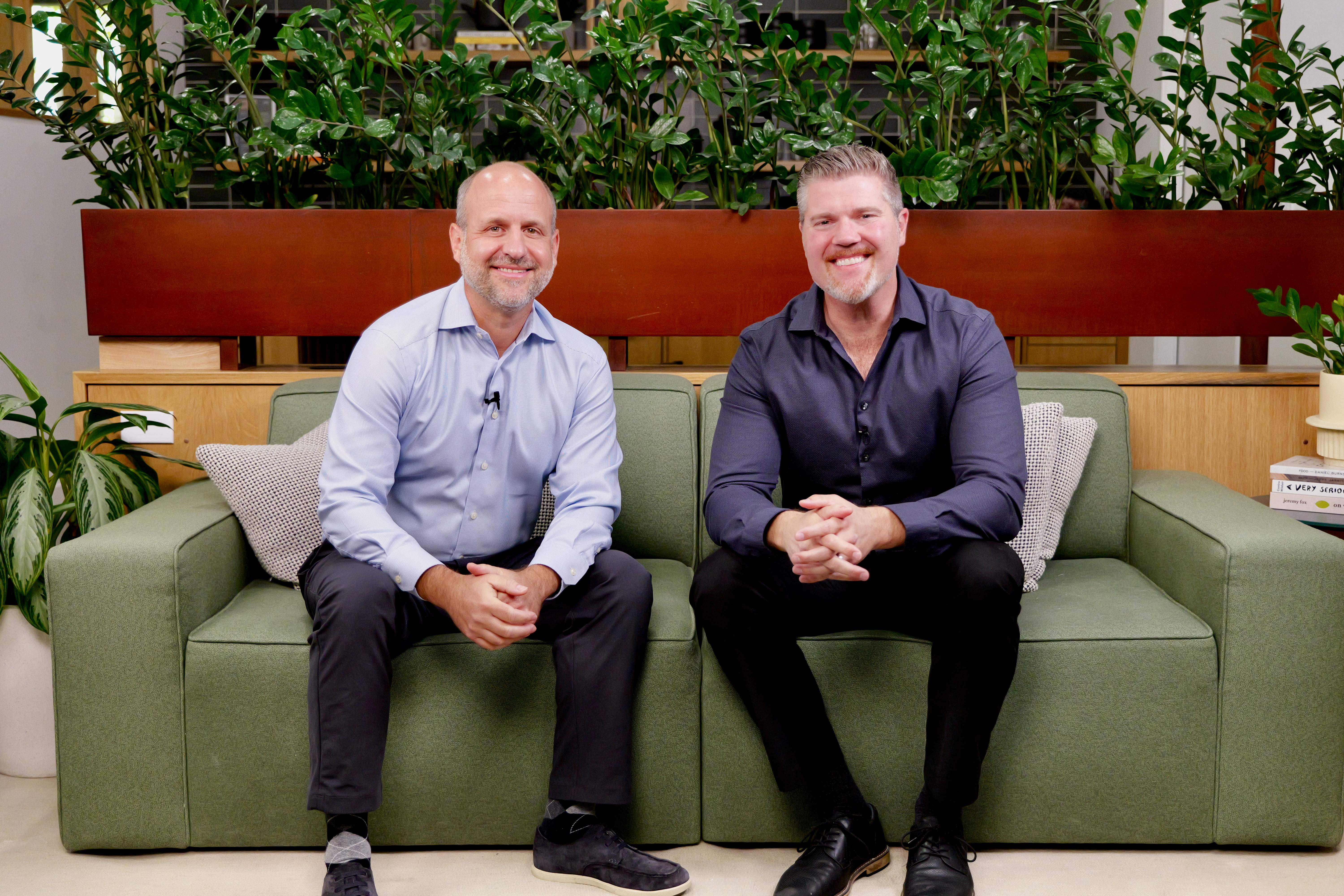
Most portfolios are built around two choices: stocks or bonds. But what happens when both go down at the same time, as they did in 2022? In this episode of Couchside Conversations, Director of Financial Planning Beau Wirick sits down with CEO Jeff Sarti, to explore how Morton Wealth thinks about building portfolios for a world full of uncertainty. Using a simple coin-flipping framework, Jeff explains the behavior behind why we make the investment decisions we do, why traditional diversification is largely a myth in down markets, and what it actually means to build a portfolio around resilience, true diversification, and income. The third coin turns out to be the most important one.
Loss aversion is not a flaw. It’s a feature — if you understand it.
Jeff’s answer to the coin flip question reveals something most investors feel but few can articulate: the pain of losing $300,000 is not equal to the pleasure of gaining $500,000, even when the math says you should flip every time. Understanding loss aversion is the first step toward building a portfolio that accounts for human behavior rather than ignoring it.
There are more than two coins.
The traditional portfolio gives investors two choices: stocks and bonds. Jeff argues this is a false constraint. Private credit, gold, real assets, and other alternative investments each have distinct payoff profiles that behave differently from stocks and bonds, especially in down markets. Adding more coins to flip, each with better odds and more asymmetric upside, is the foundation of how Morton Wealth constructs portfolios.
Traditional diversification is largely a myth in a crisis.
Owning 500 stocks instead of 5 reduces concentration risk. It does not reduce market risk. In 2008, in 2022, across virtually every significant downturn, stocks in different sectors and industries fell together. The coins became magnetized. True diversification means owning investments whose performance is genuinely uncorrelated from the stock market, not just spread across it.
Income is the truth teller.
Price can be manipulated, influenced by sentiment, and wildly disconnected from the underlying reality of an investment. Income cannot. When a private lending investment stops generating its expected yield, that is a real-time signal that something has changed. Jeff describes income as a built-in early warning system that allows Morton Wealth to triage and course correct before problems become losses.
Resilience, not prediction, is the goal.
The financial industry runs on forecasting: price targets, sector calls, market outlooks. Jeff’s view is that this is largely wasted energy. Studies consistently show that no firm predicts the future of markets better than any other. Instead of forecasting, Morton Wealth focuses on building portfolios that hold up regardless of what happens, because uncertainty is not a risk to manage around. It is a certainty to build for.
“Uncertainty is a certainty. Instead of trying to combat that uncertainty or outsmart it, it’s about acknowledging it and leaning into it. That’s a very different approach.” — Jeff Sarti
1:10 Introduction: uncertainty, AI, and geopolitical risk as the backdrop for the conversation
2:03 Coin one: $1 million, heads you gain $500K, tails you lose $300K. Do you flip?
2:51 Jeff’s answer: no, and the behavioral finance of loss aversion behind why
4:55 Coin two: $150K upside, $100K downside. Coin three: you must flip both. How do you split?
7:49 The reveal: coin one is the stock market, coin two is the bond market
9:17 Six years of bond underperformance: a dollar invested still hasn’t broken even
10:14 The third coin: finding investments with better payoff profiles. Enter private credit.
14:15 Reversion to the mean: why expensive markets produce lackluster next-decade returns
17:14 Tenet one: resilience. Building for downside protection and not for prediction
20:09 Tenet two: diversification where it matters. The magnetized coins problem and 2022
23:52 Tenet three: income as truth teller, early warning system, and why bonds failed in 2022
29:02 Closing recap: resilience, diversification where it matters, income. Beau officially coins Jeff “Third Coin.”
Watch previous episodes:
Financial Planner or DIY: How Do You Know Which One Is Right for You?
Stay and Renovate or Sell and Move? How to Decide
These are the questions investors navigating an uncertain market are genuinely asking. The full conversation, including the complete coin-flip framework, is available in the transcript further down the page.
How do you build a portfolio that can handle market uncertainty?
Jeff’s answer starts with a reframe: the goal is not to predict what the market will do, but to build a portfolio that holds up regardless. That requires three things. First, a genuine focus on downside protection before growth. Second, true diversification across investments that are not correlated with each other, not just spread across different sectors of the same stock market. Third, a meaningful allocation to income-generating investments, whose contractual nature provides both stability and a real-time signal of portfolio health. The combination of these three tenets is what Morton Wealth means when they talk about building for resilience.
Why do stocks and bonds both go down at the same time?
Traditional portfolio theory holds that stocks and bonds move in opposite directions, providing a natural hedge. In 2022, that relationship broke down completely. Stocks fell roughly 18% and the broad bond index fell roughly 13% in the same year, the worst bond performance on record. Jeff explains that this happens because bonds had been stripped of their protective function: in a near-zero interest rate environment, the income that gives bonds their stability had essentially disappeared. Without income, bonds became price-driven investments, subject to the same sentiment and demand dynamics as any other asset. When rates rose sharply, bondholders were exposed.
What is private credit, and why does Morton Wealth invest in it?
Private credit refers to loans made directly to businesses or backed by assets, outside of the public bond market. Because these investments are contractual in nature, backed by real assets, and generate consistent income, their payoff profile looks very different from stocks or traditional bonds. Jeff describes it as a coin that hits heads, meaning positive returns, far more often than tails, with limited downside even in adverse scenarios. The income it generates also provides a real-time health signal that price-based investments simply cannot: if yield drops from one quarter to the next, that is an immediate flag that something may need attention. Morton Wealth has leaned significantly into private credit as a result.
What is loss aversion, and how does it affect investment decisions?
Loss aversion is a well-documented behavioral finance phenomenon: the pain of losing a given amount of money is psychologically more intense than the pleasure of gaining the same amount. Jeff cites research showing this asymmetry is roughly two to one, meaning losing $100 feels about twice as bad as gaining $100 feels good. This is not irrational. In the context of real wealth, the stakes are genuinely asymmetric. Losing $300,000 from a million-dollar nest egg that took decades to build is a qualitatively different event from gaining $500,000 on the same base. Understanding this helps explain why protection-first portfolio construction is not just emotionally appealing but financially sound.
Is traditional diversification across stocks actually effective?
It depends on what you’re diversifying against. Owning hundreds of stocks through index funds or ETFs does reduce the risk of any single company collapsing and taking your portfolio with it. What it does not do is protect against market-wide downturns. In 2008, in the dot-com crash, and in 2022, stocks across virtually all sectors and industries fell together. Jeff uses the image of magnetized coins: when one flips tails, the others follow. True diversification, in his framework, means owning investments from entirely different asset classes, whose behavior in down markets is genuinely uncorrelated from stocks. Gold, private credit, and real estate can serve this role because they operate by different rules entirely.
Why does income matter so much in a portfolio?
Income matters for two distinct reasons. The first is practical: it provides cash flow that can replace or supplement a salary, fund spending in retirement, or be reinvested without requiring the sale of other assets. The second is more subtle and, in Jeff’s view, more important: income is the truth teller. The price of a stock can go up for bad reasons and down for good ones. Price is subject to sentiment, momentum, and the madness of crowds. Income cannot be faked in the same way. If a private lending investment is paying its contracted yield, the underlying loan is performing. If it stops, something has changed, and that information is available in real time, before it becomes a loss.
How does current stock market valuation affect portfolio construction?
Jeff draws on the principle of reversion to the mean: when stock prices are high relative to historical norms, the expected return over the following decade tends to be lower. When prices are depressed, as after a major bear market, the expected return tends to be higher. As of the time of this recording, Jeff’s view is that the stock market is expensive by historical standards, which means the coin-flip analogy may be less favorable than it has historically been. The 50% upside scenario that might follow a significant market sell-off is less likely from current valuations. Morton Wealth’s response is to hold stocks, but at a lower allocation than a traditional model would suggest, while increasing exposure to assets with more favorable and more predictable payoff profiles.
If your retirement savings are in a target date fund, you probably own stocks and bonds and nothing else. This episode is about what that means in practice, what it has cost investors in recent years, and what a different approach actually looks like.
This episode is especially relevant for:
At Morton Wealth, this is the conversation we have with clients constantly. The goal is never to predict the market. It’s to build portfolios that are ready for whatever it does. If you want to understand what that looks like for your specific situation.