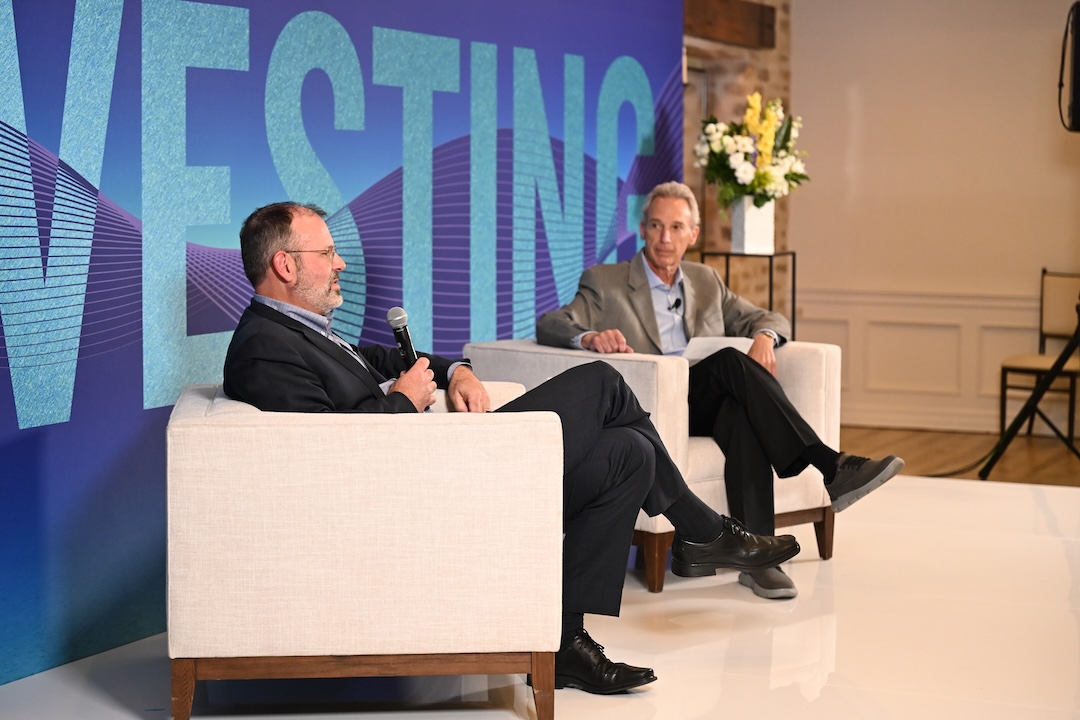
Eric Selter:
Well, I guess we're going to go ahead and get started. I'd like to thank you all for choosing us over Jeff. Personally, I would too, but just don't tell him I said that. I'm Eric Selter, I'm the senior partner at Morton Wealth. I hope you're having so far a good day and lots of sessions and things to go to.
Today we're going to discuss Morton Wealth, passion and purpose behind how we approach investments and protecting clients. Our amazing investment team has that passion of looking to diversify and make more resilient portfolios. Or as Jeff puts it, you know, having, you know, having a better boat. So we're always looking for these non correlated assets. And the investment team is always excited about following our three tenants which is true diversification and risk management.
And my favorite two words cash flow... love cash flow. So I'd like to introduce Rich Gammill from Proterra. And we typically refer to Proterra as food lending. And no they don't lend food. Rather, they provide direct lending solutions to businesses across the food and beverage value chain. And we look at that as what we call in the essential lending, meaning these aren't this is an area where people need these things or from a discretionary point of view, they're going to want these things so they can be more resilient during times of recessions or drinks, economic stress times.
And so, you know, if you're still want your orange juice at Costco, you're still going to buy your orange juice at Costco. So I'm going to start Rich with let's start with the idea of the distinction between public credit and private credit. Where does Proterra fit in?
Rich Gammill:
Yeah, I think when you think about traded credit or, you know, if you were to buy into a, a credit ETF, say, like a fidelity mutual fund, that, that, owns bonds and various companies, that's a way to get exposure to, you know, to debt or to the credit side of the credit risk or, you know, or yield.
Private credit is just simply the idea of, of, of a non-bank REIT, non-syndicated non-bank lending from a fund directly to a company. It's typically a direct loan, right, to a corporate, to, to a business borrower in the distinction being that it's a private transaction. Right. We're loaning money to that company and we're holding the loan.
We're not selling it. We're holding it to maturity. We are the lender of record and manage that relationship with the borrower and typically private credit. Then, is a solution most often used by private equity firms when they buy companies. Right. So when you hear about a leveraged buyout, right. This kind of idea of a, a private equity firm buying a company, most typically the source of debt for a private equity firm to buy a company is a private credit lender, a private lender not going to the local bank to get a loan right there.
They have a strategic lending partner that provides the debt alongside the equity that they provide to buy the company. So that's kind of the main stock and trade of private credit is to support that. But you also then have lenders like us that do non sponsor people use the term sponsor. A sponsor is a private equity firm, non sponsor backed lending which would be direct lending to just direct to companies right.
Companies that need debt solutions for growth. They non dilutive not equity. Just a loan solution instead of going to again to their local bank because banks have increasingly become quite conservative. Right. With all the regulations that have been passed and all the kind of post financial crisis changes that occurred, banks are really there to provide very kind of limited lending solutions to companies.
They tend to provide treasury services, you know, bank accounts, maybe lines of credit, a little bit of term debt against assets or something, but pretty limited. Whereas a private credit fund like us, we would go much deeper, you know, into the kind of the, into the stack of the credit of the company to provide a more complete solution.
So over the years, private credit evolved as a as a financing solution, though typically to growth oriented businesses. But you tend to get better, spreads the return opportunity to in private credit is higher than what you would find. And traded credit again back to that fidelity mutual fund example. Or if you were to buy, a credit index fund, broadly syndicated debt, usually originated by banks tends to have lower yields.
Right. Because it's a bit more efficient. It's broadly traded. It tends to be much bigger companies as well. We the other key element of private credit tends to be that private credit funds like ours are lending to lower middle market companies. Think about companies that may be at the high end or maybe 50 million of EBITDA, which isn't that small, but but 50 million or less like for us are kind of traditional borrowers, more like 20 to 30 million of EBITDA.
So these are much younger kind of growth oriented companies.
Eric Selter:
So when you say that though, why did you pick food lending? Where where did you fit in the food lending.
Rich Gammill:
Yeah, we're a sector manager. We're a little bit unique or had a lot of private credit shops would lend to any kind of company. Right. They don't. There would be a generalist. We are a sector manager because of our history. Our firm, we got started as part of Cargill. Cargill is a Minneapolis based food ag company, global ag company.
So we started inside of Cargill and we spun out ten years ago. So we were kind of by that, parentage or from history focused on food, energy. We do everything across the food spectrum, everything farmland, all the way into private equity, in the food space. And then we launched our private credit product, six years ago to do lending into that space.
So we're a specialists as a firm, all we think about is the food value chain. So we've kind of stuck to our knitting. We know that space really, really well. And so as we launched into doing lending, we stayed true to that and focused on that. So truly we've we're in that because that's just who we are. We've been doing it for 20 years.
But it's also a really nice space to lend into because as you started with, food is consumer staples, right? It's non-discretionary. We all have to eat. It's if you think about your public equity portfolio at times of volatility, a lot of time your equity manager will over allocate to consumer staples things like General Mills or Unilever, Procter Gamble, these companies that tend to be fairly low volatility because it's it's consumer spending.
It's food. It tends to be pretty reliable in terms of earnings potential or kind of quality of earnings. So it's actually a very good space to be focused on because it's fairly low risk relative to other industries.
Eric Selter:
Okay. So what's your source of alpha. In other words what's that... What's your edge that you've got that's making it work so well for you?
Rich Gammill:
So when we set off to start in private credit this is take it back when we left Cargill. So kind of ten years ago, we started thinking about how we wanted to play in the credit space. We formed a partnership with a government sponsored enterprise called Farm Credit. So probably a lot of you know who Fannie Mae is.
Fannie Mae is another government sponsored enterprise that provides, lending solutions for the mortgage industry. Farm credit. Similar. It's actually older than Fannie Mae. It's the original government sponsored enterprise. It's been around for over 100 years to provide first lien loans, to provide, you know, lending to food and AG to mostly their customers, our farmers and ranchers.
So anybody that runs a farm or a ranch tends to borrow money from farm credit. And farm credits are really unique organization in that they're essentially a nonprofit lender. They're like a credit union. The borrowers own the bank. So a farm credit is not motivated to make a profit. They have no profit incentive. In fact, at the end of every year, if they make any excess profits, they distribute it out to their members in the form of a distribution check.
So it's like being a member of your local credit union. So they're a very unique bank. And we partnered with them to develop a lending solution for the food and ag industry, where we provide a complete loan solution and you call it a unit trust loan, where you don't do kind of a traditional. If you think about an analogy to your house, like you have your mortgage and then you might have a home equity loan, so you kind of have this senior loan and then a junior loan underneath it.
A lot of times in the food, in anything in private equity historically you would have like a first line and then a second lien or maybe a sub debt piece. You know, all these different kind of lenders in a stack unit. Try to saying, hey, we're not going to do it that way. We're just gonna have one big loan that's going to do the whole, we'll do your revolver, we'll do the whole thing all in one solution.
And we've designed a unit trust loan that partners with farm credit, where farm credit buys from us, that less risky senior part of the loan, and we do the rest. So we we originate the loan, we structure it and then we sell that top half the farm credit. And what that gives us is a it essentially satisfies the farm credit requirement of kind of the risk profile they're willing to take.
And their capital is really cheap. Right. So we're able to provide our borrowers with this really inexpensive first piece. And then our piece is below that. And we package that all together. And essentially the borrower gets a better deal by doing that. And farm credit gets access to more borrowers that they couldn't otherwise call on. And that gives us essentially what we would call a structural ARB.
Right. It's, you know, in the investment management world, you would call that Alpha Alpha's excess return above what kind of the market return is. And we think we generate about 2 to 300 extra, basis points of return structurally, because we have this unique partnership with essentially a nonprofit lender, to provide a complete solution to the borrower.
Eric Selter:
But isn't another piece of your alpha the fact that you are putting together these loans, I'll call it covenant-heavy. In other words, you've got controls here to protect the investors.
Rich Gammill:
That's a very important part of private credit versus traded credit. It's this idea of a covenant. So, you know, and most loans, business loans that are privately negotiated, you have covenants in them, right, of requirements that the borrower has to meet to be in compliance with the loan. Right. Having covenants essentially protects you as the lender and broadly traded or broadly syndicated loans.
There are no covenants, right? So if things go bad, you're you're kind of stuck, right? You have to just kind of hope things don't go to bankruptcy or till things work themselves out in private credit you have covenants. And in our case we have usually we always have one many times to if the covenant is stripped. So it would be like a leverage covenant, right.
If their earnings get too low and they're they've got too much debt, we can call on the company and say, hey, you got to go raise some money. You got to you got to, you know, improve our risk position here or we may need to amend the terms. We're going to have to charge you more. We're going to raise the interest rate, or there's a lot of different things that we can do, right, to kind of manage our relationship with the borrower.
That's the unique thing about private credit. You actually have a direct relationship with the borrower, and you're able to manage your risk over the life of the loan in a very different way than you would if you were just to buy publicly traded debt.
Eric Selter:
Great. And that's really... we consider at Morton Wealth because of our risk management. We consider that an incredibly important part of it.
Rich Gammill:
I wouldn't do it any other way. Right? I mean, from obviously biased talking my own book, but if I just think about my own allocation to outside of just my own fund, right, private credit, is highly differentiated in terms of risk management to traded credit. And you also get a premium. I the currently private credit is I think when you think about getting good exposure to have, you know, have credit exposure in your portfolio, I think private credit is definitely a differentiated way to do that.
And I think there is true premium return to be had for it.
Eric Selter:
Thank you. I'm going to guess that people would love to hear like what type of companies? Or maybe even if there's a name of a company that all of us might recognize. Yeah, they kind of tell us why they needed money and what they did with it.
Rich Gammill:
Yeah. Well, we have one example of, one that, was not a private equity firm involved. Right? It's just a family owned businesses up. We're based in Minneapolis, so it's right up in our neck of the woods. It's a company called Johnny Pops. So if you if you have any kids that buy popsicles, it's one it's the leading popsicle brand in the country now, they sell a ton at Costco.
But Johnny Pops is a really interesting company. And they it was founded by two young entrepreneurs, and they were growing, and they needed some capital. And we stepped in and help them with a, a lending solution to support their growth. And we didn't take any equity. Right. So non dilutive we didn't you know they still own 100% of the company.
And we really supported us pretty substantial growth in their business. From what was a fairly young company when we got involved to the day. It's a very substantially profitable business. So we do some of that. Another one, that we did recently is a company called woof. If you have dogs, you know that they're a pet treat company you buy on Amazon.
It's the little toy that you put the little treat inside selling like hotcakes. They're one of our portfolio companies, again, not a private equity firm involved. We just provided a lending solution to the company to support their growth. So we get involved with things like pets, any kind of food related or food value chain related. So those will be examples on the non sponsor side.
Another example would be on the private equity firm side. We backed the company that bought Tillamook beef jerky. It's, it's so not the cheese side of Tillamook. It's the beef snacks or beef jerky side. We provided the credit or the debt to, to a private equity firm that bought Tillamook. So it's another example.
So we do everything from, you know, pet to beverage to novelty, like, Johnnie Pops into something like a snacking company like that. The final one we actually did, recently was also the number one provider of popcorn. So they do all the microwave popcorn. It's called Weaver popcorn. So if you go to Costco and buy the Kirkland Direct brand of microwave popcorn, our company does that.
So these are not really kind of super sexy high growth businesses. These tend to be very kind of reliable growers, companies that do kind of consistent earnings. The average age of our portfolio company is 50 years old. So these tend to be family owned businesses where they're selling maybe to a private equity firm as an exit, or bringing in private equity firm as a partner.
And we're helping to finance that growth. But the point, I guess I would say about our strategy is where we lend to performing credit. We don't do distress. These tend to be fairly low leverage type. But the average leverage on our portfolio is under four times, which is pretty low leverage. And we don't look for companies. I mean, we've never had a loss in our history.
So this is performing credit kind of traditional middle of the fairway. In fact the loan to our borrowers, it's a very it's kind of we intend to be boring. Right. We're not trying to do anything particularly edgy or innovative as it relates to the loan itself and to the type of companies that we work with. We're really to supporting the growth of essentially the US food system.
Eric Selter:
Well, the fact that you've never had a loss in your guy's history, I think it says a lot about it between the covenants and also that your due diligence on those companies.
Rich Gammill:
Well, yeah. I mean, and so you say cash flow matters to us a lot. So everything that all of our loans are cash pay interest. And we also generate a lot of fees. So those of you that have invested, you know, into our fund, we, you know, we, we distribute earnings every quarter. So, you know, every quarter, we, we essentially distribute all interest and fee income out to our investors.
And that's been running, you know, north of 10%. So we generate pretty good current income I guess is the point to investors and right, you know, in this kind of market with, you know, things like the stock market at all time highs, maybe people aren't valuing income or cash flow as much, maybe in certain markets. But I think we will be an all weather type strategy, because of the nature of the types of credit.
Income and cash flow is very important to us.
Eric Selter:
So what would make you... if a company came to you and said, we want to borrow this much money, talk about what would make you say, turn it down? And or would it also make a difference if they are using it to expand their operation, like with equipment versus we've trying to go market more?
Rich Gammill:
Yeah, use of proceeds does matter. I would say kind of yeah. Why are they borrowing the money. Are they doing it just to take cash out of the business? Kind of like in a back to the old example I keep using in your house, like when you talk to your mortgage lender, is it a cash out refi or are you just taking money out of the house to go put it in your pocket to go buy a speedboat?
Are you putting that money into a add addition onto the house that's going to make the house more valuable? So for us, we think similarly, like what's the use of proceeds? Is this going into growth or is it just going into the honor to, you know, to want to put some cash in their pocket? That's certainly one consideration.
I would say the biggest consideration for us, though, is how risky are the cash flows of the business, how risky is the business itself? And to use the analogy of like, what could cause the business to fail and then food, you have to, you know, there's a lot of scenarios that you have to kind of run through.
And the nature of being a lender is you're always thinking about what could go wrong, right? You're not really because you don't get paid for the upside case as a lender. Right? You don't have equity. So you're really thinking about the downside case is really how you underwrite and for us the biggest one is customer concentration. Right. So in the food beverage space, right.
A lot of times the issue could be, is that if you have, say, 90% of your business with Costco and Costco, just for whatever reason decides not to carry your product anymore, that's a pretty bad day for that company. So we spent a lot of time looking at channels for revenue. How many different, you know, channels are they in?
Are they in Walmart or are they in target? Are they in Whole Foods? You know, are they in Trader Joe's? Like, you know what, how many channels of distribution do they have? That's a big one for us. So customer concentration is a big one. I think the other element is just manufacturing. Could they have like a phytosanitary issue, like a listeria outbreak or something like something that would cause the their production facility to have to close in our world, that's kind of the kill shot for, for a food beverage company.
And we really have to be thoughtful about. Do they have diversified manufacturing? Right. Are they can they withstand something like that? So we tend to live in that world of what could go wrong. But the nice thing in food and beverages, the volatility is pretty low. So it's we haven't really in our history had any substantial, you know, issues like that.
And, and we really I think I've done a good job of avoiding kind of we don't really get involved with the hot new energy drink company that's only been around for a couple of years, that sort of thing. That's just not who we are. We're not trying to be kind of venture back, type companies, they tend to be mostly manufacturing companies.
Honestly, food co manufacturers that do a lot of private label. And that's frankly a massive trend in the food space anyway, as with food inflation. Right. All of you have seen at the grocery store, right. Prices have just really continue to go up increasingly grocers, you know, Trader Joe's, Whole Foods, you name it Kirkland. They're moving to their own private label.
Right. And so a lot of our financing has been, frankly, to food manufacturers that are doing a lot of work for the for the retailers, for private label. And that's also very resilient because it's a label. It's the brand owned by the retailer. They're not going to stop carrying that because it's their own product. So that tends to be quite low risk.
Eric Selter:
Do you have a favorite food or industry or particular one say? Well, we've always had such great luck with that one. We really like doing this. It's easier for us.
Maybe we're you know, we really don't kind of come at it from the perspective of kind of trends or themes that we like the most. It's very much around kind of where the equity dollars are going, like where the private equity firms are investing, but it's most definitely around where we all are shifting our own dietary habits. Right.
So I use the analogy of if you could have taken a picture of the inside of your refrigerator ten years ago and then compare that to one that's in it right now, it's real different, right? Like we're all shifting how we eat. And it starts with dairy, right? People are switching to different, you know, nut milks and alternative milk and dairy products.
We're going I mean, organic has been out there for a long time, but that's a continued trend. Cleaner labels. Right. Thinking about Whole Foods shifting really in how we think about, what kind of worked on those cleanly so, you know, healthier, better for you. Those types of trends drive food and those are being driven by many times kind of independent, growing companies and brands, right, that you're getting to know through your retail most often the natural grocery channel.
So that's where our money is going because that's where the growth is, because that's where everybody in this room and all, you know, because we're all eating a little bit different. It's not center of the store anymore. Right? It's more in the refrigerated section. It's it's more on the edges of the store. And that tends to be where a lot of new money is going in to support the growth of these types of brands.
Eric Selter:
Okay. So earlier, we talked about covenants and how important it was to be covenant heavy.
Can you give us a more story or two about where you had some strong covenants and you said, wow, it's a good thing we had those because we were able to do this.
Rich Gammill:
So in our history, we've had one company where we actually had to step in and take over. It was the very first investment we made out of our very first fund. It's a blueberry operation in Florida. And, it's a great company. We're actually about to sell it. We took it over and got it up, you know, kind of cleaned up and fixed up.
And it's a profitable company. And we're we're actually about to sell it to a very large kind of diversified berries. Operator. Out of Georgia. But when we stepped in, we were able to step in because we had these covenants. The shareholder was basically underfunding the operation. And they weren't taking care of the bushes. Well, they weren't managing the product very well.
And it was because they were short on capital. And it wasn't because they were bad people or something, you know, that they were basically undercapitalized and one of the reasons they were a bit undercapitalized is the year before a hurricane had moved through Florida and had basically affected the operation, and they really couldn't kind of fix it the way it needed to be fixed, because we had the covenants that we had and we had the security that we had, we could essentially step in and say, okay, we're taking over, foreclose on the operation.
We took over the full operation outside. We didn't have to go through a court, you know, settlement. It was all handled outside of court. And we basically stepped in, completed the project, fully funded it, and, you know, and now we're selling it. But that's a good example of if we didn't have that, they would have been able to hold on to it, underfunded and probably ultimately fail.
And then we would have to resolve that in the bankruptcy or ultimately to kind of take over the operation that way. But by then they would have destroyed, you know, all the value of the farm that we had originally back. So having those kind of preemptive rights, the ability to step in when things are starting to go wrong and do something about it.
Well, before you get involved with like a bankruptcy, I think is an essential example of that. And it served us well. And we're going to get our full capital back.
Eric Selter:
You have a question there. Go ahead. Question.
Rich Gammill:
The couple of examples you mentioned, which are really good at that sort of kind of consumer packaged goods space for manufacturing operations.
Can you talk a little bit about, how ag lending is different?
I imagine it's quite different.
It is quite different. And to be clear, we do not do any ag lending. So we don't loan money to farmers farm credit. Does our strategic partner does a ton of it right there. They have over $400 billion in loans outstanding. They're a very large financial institution. That's really an asset backed loan. If you think about, from a farm, whether it's a farm or a ranch, the product of the company is a commodity, right?
And they don't have any pricing power. And a big thing for us is we need to have pricing power. So it got to your kind of classic econ 101 class price taker versus price setter. We want our companies to be price setters. If you have a brand or you manufacture something, you get to set the price of it.
And so when we saw like during Covid, right, huge increases in the price of butter, eggs, oil, all sorts of stuff. So food got a lot more expensive and our companies were able to pass that price through. That's why we've had so much food inflation. I mean, it's not great for us as consumers, but it was really good for us as a lender, right?
Our companies were able to essentially maintain margins. Whereas a farm, if you're in production AG, you have a lot of volatility. And that's why lending to farmers and ranchers is really an asset backed loan. You're really underwriting the value of the real estate, the dirt, and knowing that, hey, maybe at 60% loan to value or you're probably good, but you're not really thinking about it from a cash flow standpoint, you're really underwriting it from an asset standpoint.
And there are folks that do that. You know, Farm Credit does a lot of it. We just that's not our kind of where we lend to cash flow. Positive operating companies have really avoided ag lending. The other thing for me that we've and as a firm we've owned, we we are at the peak. We own over 500,000 acres of farmland.
So we're big owners of farmland. We don't lend to it because I don't really like the idea if something goes wrong that ultimately you're having to foreclose on the farm. And a lot of times that farm is going to be owned by a family farmer. And that's just not a business I want to be in.
So I grew up in Fargo, North Dakota, and half of my family are farmers. And ranchers. Like, I know it's a volatile business and that's a tough business to be in. There is money to be made as a lender into that space. But we've really avoided that world. I think maybe partly to start a personal bias of my own.
And I've seen that over the years how people have, you know, it's a tough business when things get tight. I don't relish the idea of having to foreclose.
Eric Selter:
I want to thank Rich for coming today. For those of you who are invested in Morton Wealth, 83 investment Group income fund, they are one of the managers in it. So we're pretty excited about it. We used to invest with them directly, but now we've put it into the income fund. If you want more information, I think Rich is going to be around.