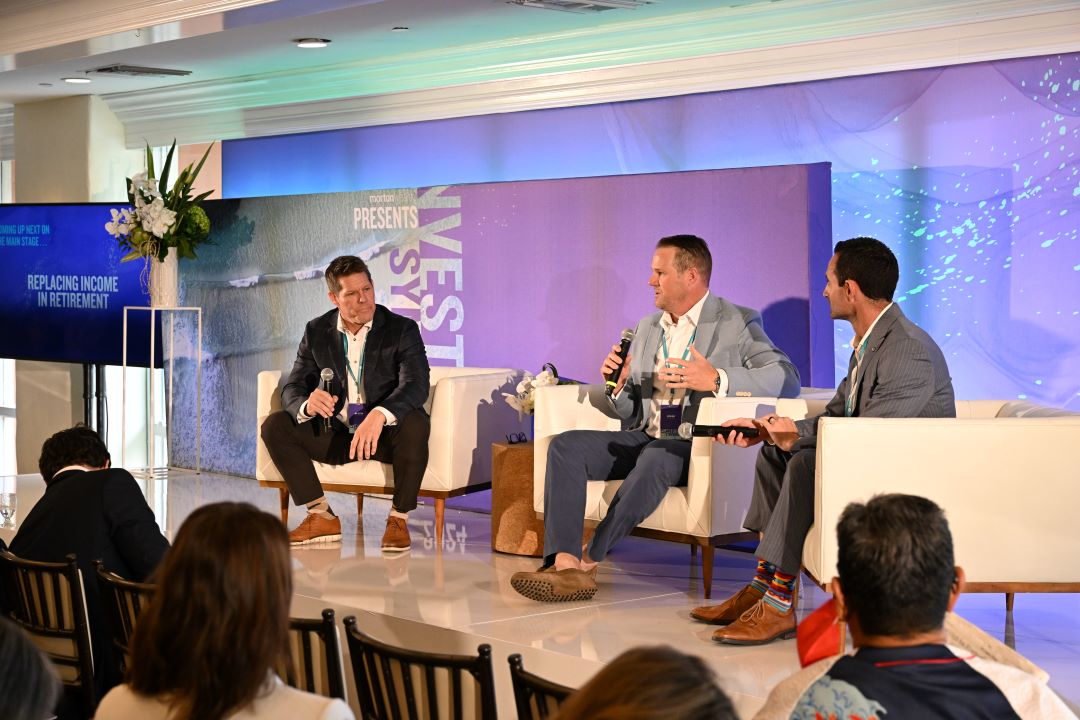
Kevin Rex: Appreciate you all being here. My name is Kevin Rex. I'm one of the wealth advisors at Morton Wealth. Just over the summer, we had a family party. I'm sitting down with my Aunt Jane. She is someone I've looked up to for a very long time. Because she's built her own successful business, she's always working hard. So whenever I see her, I'm just like, man, there are so many qualities I admire about her.
And so we're talking about, Aunt Jean, when are you going to sail off into the sunset? When are you going to retire and just enjoy all the wealth that you've created? And what was interesting is her face changed a little bit. She's like, Kevin, where would my income come from to support my lifestyle?
It comes from the business. So how am I going to get a paycheck if I stop working? And in my mind, it was crazy because she was incredibly successful. She had built a nice net worth, but in her mind, her business was her bloodline. And so I'm excited today to be here with Joe Seetoo and Mike Rudow - two of my partners and incredible advisors who specialize in helping create income in retirement.
They have a unique skill set working with business owners, so I'm excited to tap into that and really help you guys understand where to look at for income replacement in retirement. So what's interesting about retirement before we even get to the income piece?
It's the identity piece. And so before we even get into income, Joe, I'd like to start by how do you work with your clients as they approach retirement from just a global picture?
Joe Seeto: That's a great question, Kevin. Yeah. So the cornerstone is starting with a financial plan. Right. And so, you know, you can imagine you're never going to go on a journey blind. And you're taking a journey into retirement. Doing the planning gives you the clarity that someone needs to think about, understanding where they're at today and what does life look like ten, 20, 30 years from now, which gives you the certainty of the decision you're making and have confidence moving forward. I'll share with you a quick story. Actually, over the last month, we were working with a woman who was actually in her 70s. She has been the primary breadwinner for her family for the last 40 years. Her husband was actually disabled pretty early on in his career. And so you can imagine the sense of responsibility that she has with this decision.
It doesn't just affect her, it affects her husband, it affects her kids. And what she said was once we got through the plan, the sense of relief, of having the visibility of where the income is going to come from, what their expenses look like was just tremendous. So it starts with that. The second cornerstone, and it's been talked about a lot already: mindset.
You know, Jeff our CEO has a great, a little equation that we use it more in, which is a better mindset and a better strategy equals a better outcome. You know, I think for those transitioning to retirement, a lot of it is this mindset shift around you've been saving, you've been accumulating, you've been a doer your entire life.
I mean, that's how we're raised from. Right? Once we get out of college, to think that that mindset is going to just sort of shift overnight, that's not natural. It's more of a process. And this is really where I think our advisors stand out in coaching our clients and partnering them through that emotional journey and helping them with that shift in mindset.
Kevin Rex: Yeah, I do think the mindset piece is actually the hardest piece. The strategy we can kind of figure out. But getting someone to think through, what am I going to do? Where is my identity? Like where is the income going to come from? So I'm glad that we work a lot on that. As far as retirement goes, though, I think retirement has really shifted.
So when I think about how my parents viewed retirement or even my grandparents, can you talk a little bit about how retirement is viewed today versus in the past?
Joe Seeto: Yeah, I think there has been a big shift in the sense that, you know, it seems to be this idea of the line in the sand, like, when are you going to retire a certain date? This sort of like all or nothing approach that we as humans, kind of like we like black and white. We like certainty. Yes or no.
The reality is it's more of a process, right? I think if we approach it this wa we're seeing more people actually do. Is this a longer transition? Maybe instead of working 40, 50 hours a week, they're cutting back to 20 with the same company. Maybe they're doing consulting, maybe doing part time work with another business, but approaching it more in this stair step process, seems to be more of what we're seeing consistently with the clients we're working with.
Kevin Rex: And not only has retirement kind of shifted, the landscape has shifted. So moving into the right strategy, right. We talked about mindset. Better strategy equals better outcomes. What's the landscape like today versus maybe ten, 20, 30 years ago. And how should people be thinking about it.
Mike Rudow: Well, yeah. When you think about the landscape we're thinking about the income landscape. Right. And the income landscape has changed dramatically. And it continues to change. I mean, bonds, traditional bonds, government bonds in a portfolio don't offer the same attractive yields or the protection that they did historically. I mean, let's just use an example and think of your great aunt, who was the original entrepreneur of the family, and she decided to retire back in the 1970s, when the 70s, she would be able to take part of her portfolio and allocate that into government bonds that had attractive returns, 8, 9% with very little risk and good protection against a fluctuating equities market.
Now fast forward, and if your aunt decided to pull the trigger in the 90s or, early 2000s, same story, she's able to get 6, 7% with very little risk, income from government bonds, good protection in the portfolio. And then fast forward a little bit more in 2008. We've got the great financial crisis. What happens then is interest rates have to come down to stimulate the economy and interest rates...
The borrowing rate stayed at almost zero for almost 12 years. Right. And in that scenario now... fixed income, you know, you've got your traditional bonds aren't paying off any return, but you're taking on tremendous risk because interest rates have nowhere to go back up. And when interest rates go up, the price of one falls, right. So then we see Covid hit stimulus being injected in the economy, and then inflation rears its ugly head.
And now interest rates are forced to shoot up. Prices of bonds fall, stocks fall at the same time, investors have nowhere to go. So it's you feel hopeless in the traditional mindset where if you have stocks and bonds or bonds, we're supposed to protect your portfolio. Now you're stuck. Well, that's we think differently, right. And we look for uncorrelated assets.
So we're always looking at investments that could generate income in places like private lending or private mortgage pools. We've got asset based lending. We've got necessity lending. So thinking outside the box, generating income without having to rely on, you know, the conventional investments.
Kevin Rex: Yeah, it can be scary if again, you don't know what investments to utilize to generate that income, especially in a fluctuating interest rate environment. Quick plug Meghan Pinchuk, our chief investment officer, will be speaking specifically around the investment types that we utilize to generate income investment stage a little bit later today. It's a don't miss situation. But, Joe, can you give us a few examples of investments that we're utilizing today that focus on income, that help mitigate some of the risk or interest rate fluctuations that Mike was talking about?
Joe Seeto: Absolutely. How many of us are either have had a mortgage or still currently have one? Right. Pretty familiar concept, right? Something we've been doing for a number of years is these private real estate loans with many of the managers you have a chance to meet later on? Why do we make those payments on a regular basis? Because we know we want to make sure we stay in our home, have the utility value of our house, and not lose the equity we've built up.
Similarly, if we're the bank, which essentially we are collectively, if we're providing the capital for those loans. I'll give you a very specific example. One of our managers shared with me recently, where they provided a loan on a short term basis, 12 months, to a gentleman who had a net worth of north of $100 million, nine figure net worth.
He was buying three educational properties, or three properties ever leased, to the tenant, which was a business that was an early education platform. Education tends to be pretty resilient as a business. It continually is getting funding. And the term of the loan again, 12 months at 12%. Right. So when we think about how we're hedging inflation, that rate is substantially enough to cover inflation risk.
The loan to value, right, if it's a $10 million loan, was at about 16 million in value, about a 60% loan to value. So the borrower had a lot of equity on the table that they would be forgoing if they ever default on this loan and were in first position. That's one of many examples of the kinds of loans that our managers are sourcing to put into the mortgage pools that, again, we feel are a little bit more resilient than just traditional bonds. On the, you know, separately what we call private diversified lending.
You can think of business assets, machinery, equipment, inventory, as the substitute for the real estate. So businesses are pledging those assets in many cases. Or there may be businesses that are very cash flow positive and more necessity-based businesses like, like food, right? It is a particular industry that is not as sensitive in the economy.
How many of us here like salmon, by the way? Yeah. All right. I'm almost all hands on up. Would you be surprised to know that the salmon market has tripled in value over the last 15 years? Tremendous growth. And so our food lending specialist structured a $40 million loan with this business that was growing.
They needed to expand marketing operations. And a very senior secured position, this $40 million loan was priced again at a ten, 11, 12% yield over a short term, 2 to 3 years. Again with, certain contractual pledges. And and so, again, more resilient income in a growing market that is, again, uncorrelated to the traditional bond market.
Kevin Rex: Yeah I think salmon's in keto, Mediterranean paleo. It's in every diet. Right.
Joe Seeto: And we all need to eat right.
Kevin Rex: And we all need to eat. It's essential. So we thought back to when Covid hit and everything seemed to be pretty correlated. We still needed milk, butter, blueberries, salmon. We still had to eat. And so it is a resilient marketplace and a nice way to diversify assets and diversify income. So shifting over to you, Mike, what other types of diversification should people in retirement or approaching retirement think through?
Mike Rudow: Yeah, well we talk a lot about portfolio diversification. But something that we don't talk as much about is diversifying your account types. Right. It's important to have taxable and nontaxable accounts when you're approaching retirement so that you can have a diversified tax strategy, and have flexibility when taking income.
Now I'm going to lay out the account types first and then I'll give you an example. So you've got your traditional IRA. With that you're not paying any taxes going in. But then you get tax deferred growth. And anything that comes out of the IRA is going to be taxed at ordinary income. And you've got a Roth IRA and a Roth IRA.
You're paying taxes upfront on the money that's going in, but then you've got tax deferred growth and any money that's going out is tax free. And you've got your traditional accounts, whether it's a trust or a TOD, and you're going to put after tax dollars in there, you're going to establish a cost basis. Any growth on that is going to be either short term or long term capital gains.
And any income that's generated is going to be recognized in that tax year, whether it's ordinary income or qualified dividends. And then there's another count that some could qualify for if they have a high deductible plan called an HSA, which is the only triple tax benefit plan where you're getting pretax dollars in tax deferred growth and then no tax on the money on the way out, as long as it's a qualified medical expense.
So let's take your aunt as a business owner, say she retires, but all of her money now is in an IRA because she's just stored away money going into a retirement plan and she's now rolled into an IRA. Well, she needs 200,000 of income to maintain her lifestyle. Well, she's going to have to pull $300,000 out of that IRA every year, which is going to put her in higher tax brackets, and she's not going to have any options to really mitigate that tax strategy and, because she's in higher tax brackets that can make more of her Social Security taxable.
And it also can make her Medicare premiums go up. Now take that same situation and add a Roth IRA and a TOD and an HSA. She could mitigate taxes by only taking enough out of that IRA to where she's still in the lower tax brackets. Maybe she takes 100,000 so she actually nets 60 out of that, and then she's taking some out of her HSA for medical expenses.
And then she splits the difference between the Roth and the traditional account. So there's a lot more strategy that can be involved when you have a diversification of account types, just like when you have a diversified portfolio.
Kevin Rex: Yeah. One of my favorite strategies, which is a diversified strategy and tax diversification, is using cash accumulation life insurance. So you have the Stream protection plan where you put your money invested in the market. You have a floor of 1%. So you never take losses. So you have that protection. You can use things like bank leveraging, that cash grows tax free and then it comes out tax free.
So trying to look at all the options to not only diversify the risk but also diversify the tax risk is extremely important. So I'd be remiss if I didn't tap into your expertise and knowledge around business owners. As we know, business owners are complicated. We know that typically their businesses, their first born child, they've spent their whole lives building it.
It's challenging to think about exiting a business, most importantly because they don't want to give up control. But then also, as we talked about, where does that income come from? Joe, can you talk about how you work with business owners specifically around planning for income as they get ready to grow and then exit their business?
Joe Seeto: Yeah, for business owners in particular, it's challenging because there's so many moving parts. The business, their own personal plan and then their own life goals that they're trying to accomplish. But specifically owners, businesses have four sort of unique levers that Mike and I talk about when they're thinking about transitioning out of their business. One is separating ownership from management.
Next would be a rollover, or an earnout, I should say, a seller note. And then lastly, an employment agreement or staying on as a consultant. So we'll talk about what I call separating ownership from management. When a founder starts a business. Right. They are wearing literally every hat- they started the business or the visionary. They're the operator.
They're conflated all these roles because they're literally doing it all. And so when it comes time to step away, the idea of actually handing over the reins, they can still own the business, right? The ownership piece, but actually having someone manage the business on a day to day basis feels foreign to them. And Mike, actually, and I work with two clients over the last six months where one, we helped him elevate the owner and internal employee to the level of the CEO.
And then another. We actually went out to the market and found an operator who was specifically to that industry, that industry knowledge for him, the owner, to bring in to actually operate the business. Now the benefit is the owner continues to maintain the dividend and the cash flow right into retirement. They still have an upside if they decide to sell in the future.
It does add a layer of complexity because this is something new. They never gone through before. So there are some pros and cons to that. Mike, do you want to talk a little bit about the earnout structure?
Mike Rudow: So an earnout is another opportunity for a business owner, and that's a sales structure where part of the sale of the business is actually dependent on the performance of the business after the sale. So I'll give you an example. Let's pretend Kevin, that you and Nicole own an insurance business and you guys are thinking about selling that insurance business for $10 million, because that's the valuation that you got.
But from the comprehensive financial planning that you guys did at Morton Wealth with your amazing financial planners, you realized that you only need 7 million to sail off into the sunset and live the life that you want to live. Well, one of the ways that you could then sell that business is put it for sale and take that $7 million upfront and then have a $3 million earnout where now a buyer is coming in and they're taking less risk because you're telling them, well, my business is going to continue to grow at X level.
And they're saying, okay, well we're going to give you 7 million now. And now we need to get in line, because I need you to keep hitting those growth goals for you to achieve that next 3 million. So you have to hit, you know, certain revenue targets, you might improve profit margins or retain clients, but in a way, it's a way to align the buyer and the seller and also take some risk off the table for a buyer coming in, that might be a owner centralized business.
Joe Seeto: And then the third structure, let's go to your aunt Jean.
And so a seller note is a financing tool that can be used oftentimes. So we're seeing, you know, because of what's happened in the banking industry, when rates were zero, I mean, money was cheap. Now things have shifted. And so you're seeing more seller notes. It's a financing tool to bridge the gap between what a buyer is willing to pay and what a seller sort of really needs to write off into the sunset.
And rather than, and let's take Aunt Jean's business, maybe it's going to sell theoretically for for $10 million. That's the valuation. But the structure is such where a buyer will only want to pay 7 million today. So she maybe gets that cash. Now, the other 3 million is in the form of a promissory note that principal payments and interest will be paid out over the next 3 to 5 years.
So that's a way, again, to structure cash flow for Aunt Jean as she's transitioning into retirement. The benefit is that a deal gets done that probably would have not otherwise gotten done. The downside tends to be that your note as a seller will often be subordinated to the bank debt that is in the deal, and you have to make sure that the acquiring party can manage the business as such, because you're taking on credit risk that they can fulfill their obligations.
But as a creative structure, we see, for owners to consider.
Mike Rudow: And then in the last one that we see, which is usually the most fun one because it means freedom. And that's consulting. Business owners are dedicated to their business for their whole lives, and they acquire tremendous knowledge and expertise from what they've been doing. Now they sell their business, and maybe they want to still feel important, or still utilize all of that knowledge and skills that they've acquired through the years.
They can become a consultant. They can consult for the business that they just sold. They can consult for another business in the industry, maybe a competitor. But now they've got the freedom of time where they can go and start to pursue the things they wanted in retirement, but also have that ability to generate some income, utilize their skills and knowledge that, which is a great way to kind of ease into retirement.
Kevin Rex: You guys are awesome. I'm learning stuff as I sit here, even after we've gone through the practice session. So just in wrapping on this, if you're in retirement, if you're approaching retirement, some of the key takeaways for me is one- have a plan. It is so much better to know what the risks are, to know where income's coming from.
It's a peace of mind and being able to sleep at night. It's the right mindset and the right strategy will lead to better outcomes. Diversification is key. So diversification of assets to protect the downside. But also diversification of account types. Diversification of taxation is really important. And then lastly if you own a business or know someone that owns a business, then think about my aunt like, of course she needs to talk to you because there are so many options.
There's so many complexities around how you can exit. It's not just sell and leave. Like the consulting thing is incredible because it gives you peace of mind. It gives you identity. It kind of works with both those pieces.
Joe Seeto: And it's such an underserved market. Right? I mean, I think that's one of the things we're passionate about at Morton is the fact that the industry at large, generally speaking, is looking to manage liquid assets, and we do a phenomenal job at that. But most owners pour their heart and soul into the business. It represents the lion's share of their net worth.
And yet they're oftentimes not getting the help they need ahead of the transaction. And it's something we're passionate about changing.