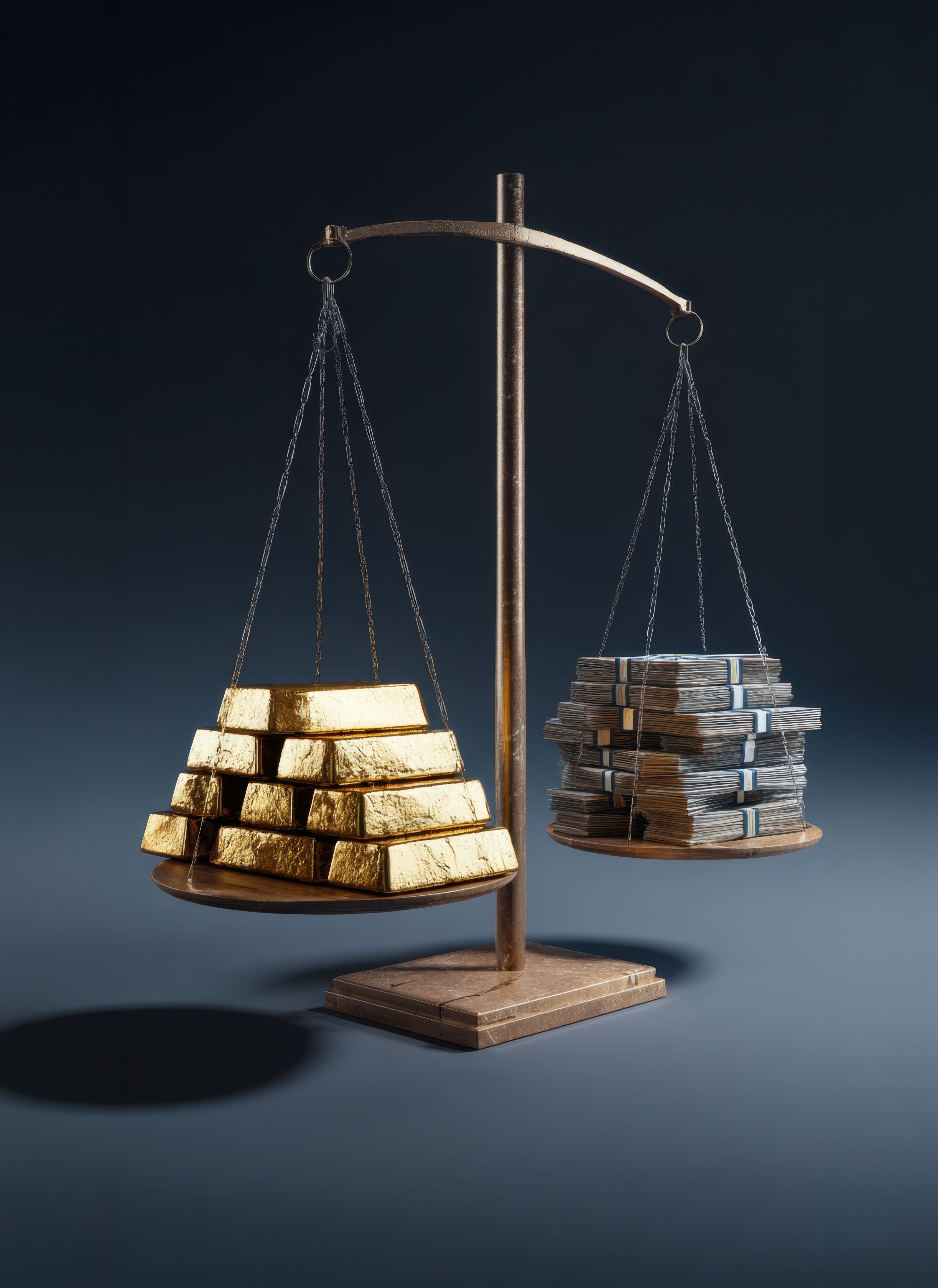
Gold has been a core portfolio allocation at Morton Wealth since 2015, and its recent rally, from a previous peak of $850 an ounce in 1980 to roughly $4,500 an ounce today, has raised new questions about inflation, the U.S. dollar, and government debt. This issue of The Healthy Skeptic explains why Jeff Sarti views gold as a store of value rather than a speculative trade, how the expanding M2 money supply is eroding the dollar's purchasing power, and why gold may still have room to rise even after its recent gains.
Key Takeaways
Morton Wealth instituted its gold allocation in the summer of 2015, treating it as a core, decade-plus portfolio holding rather than a short-term trade.
Since 2015, gold has returned 13.8% annualized, narrowly outperforming the S&P 500's 13.1% over the same period, even though Jeff Sarti argues gold's long-term expected return should be a modest 2% to 6%, in line with dollar debasement rather than stock-like growth.
The M2 money supply has doubled from $11 trillion in 2014 to $22 trillion today, a pace Jeff Sarti estimates degrades the dollar's purchasing power by roughly 6% per year, well above the 2.6% average annual inflation reported by the Consumer Price Index over the same period.
Since 1980, gold has risen 5 to 15 times depending on the timeframe, but that trails other measures of dollar erosion: global financial assets are up 25 times, average MLB salaries 33 times, and federal debt 42 times, from $900 billion to $38 trillion.
Western investors remain largely uninterested in gold: the number of shares outstanding in gold-linked ETFs is still below its all-time high from five years ago, even though gold trades near $4,500 an ounce today compared with roughly $2,000 an ounce back then.
Questions This Newsletter Answers
Why does Morton Wealth hold gold in client portfolios?
Morton Wealth instituted a gold allocation across client portfolios in the summer of 2015 and has maintained it as a core holding since. Jeff Sarti's rationale is straightforward: gold is a store of value, plain and simple, meant to protect purchasing power against a currency that is steadily being debased.
What does it mean to call gold a "store of value"?
Jeff Sarti illustrates the idea with a simple example: if the supply of dollars in an economy suddenly doubled, prices would eventually double to match, but a gold coin would still buy the same amount as before, since no new gold could be created out of thin air. The dollar's purchasing power gets cut in half while gold simply holds its value.
How has gold performed since Morton Wealth added it to portfolios in 2015?
Gold has returned 13.8% annualized since 2015, narrowly ahead of the S&P 500's 13.1% over the same period. Jeff Sarti is careful to note this outperformance is not the expectation going forward. Gold's long-term role is to track the dollar's rate of debasement, which he estimates at roughly 2% to 6% per year, not to outperform productive assets like stocks.
Why does Jeff Sarti believe official inflation understates the true cost of holding dollars?
The Consumer Price Index shows inflation averaging 2.6% per year between 2002 and 2025, but Jeff Sarti argues the more accurate gauge is the growth of the M2 money supply, which has doubled roughly every 11 to 12 years, implying the dollar's purchasing power degrades by closer to 6% annually.
Has gold's price already gone up too much?
Jeff Sarti acknowledges gold's near-vertical move in the last year or two gives him pause, and Morton Wealth periodically rebalances the position to lock in gains. But he argues gold, at roughly $4,500 an ounce, has actually risen less than several other measures of dollar erosion since 1980, including global financial assets, average salaries, and federal debt, suggesting further room to run rather than a bubble.
Why does Jeff Sarti see potential further upside for gold despite modest return expectations?
Western investors remain largely uninterested in gold. The number of shares outstanding in gold-linked ETFs is still below its all-time high from five years ago, even though the price of gold has more than doubled since then. Jeff Sarti argues that if Western investors eventually catch up to the demand already coming from central banks and Eastern investors, or if government debt policies continue unchecked, gold's price could rise faster than his modest base-case estimate.
Why This Matters
For Investors Inheriting or Stewarding Wealth
If you are focused on preserving wealth across generations rather than growing it through continued risk-taking, this issue speaks directly to that goal. Jeff Sarti's point about the ultra-wealthy is worth sitting with: much of the wealth created in recent decades has been a byproduct of asset prices rising faster than the dollar itself has weakened. Protecting what has already been built, rather than continuing to bet on outsized appreciation, is exactly the mindset shift this issue describes, and gold's role as a store of value fits squarely into that kind of stewardship.
For Investors Seeking Alternatives
If you already hold gold, or are weighing whether to, this issue lays out Morton Wealth's actual return expectations in plain terms rather than promotional ones. Gold is not meant to outperform stocks, and Jeff Sarti says as much directly. Its purpose is closer to insurance: modest expected returns most of the time, with the potential to do real work precisely when other parts of a portfolio are under the most pressure.
Full Transcript
By using this website, you agree to our use of cookies. We use cookies to provide you with a great experience and to help our website run effectively.